Payment Terminal Customer Identification: The Technical Guide
Roughly 85% of UK retail transactions now happen on card , according to UK Finance's 2024 Payments Markets report . Each of those taps...

Updated: 6 April 2026
Roughly 85% of UK retail transactions now happen on card, according to UK Finance's 2024 Payments Markets report. Each of those taps and dips generates a data trail — yet most merchants cannot connect two visits from the same customer. The card terminal already knows who is paying. The question is whether anyone is listening.
Payment terminal customer identification is the practice of recognising returning shoppers at the point of sale using data already present in the transaction flow. No apps. No sign-up forms. No loyalty cards left in a kitchen drawer. This article explains the technical architecture behind it, the privacy framework that governs it, and the practical impact it delivers for retailers, ISOs, and acquirers.
What Payment Terminal Customer Identification Actually Means
The existing SERP results for this topic focus almost entirely on Terminal ID numbers — the eight-digit TID assigned to a device for routing and reconciliation. That is machine identification, not customer identification. The distinction matters enormously.
Customer identification at the terminal means recognising the person paying, not the device processing the payment. It uses tokenised representations of card data — derived from the Primary Account Number (PAN) — to build a pseudonymised profile that persists across visits, locations, and even terminal hardware swaps.
Think of it as the in-store equivalent of a browser cookie, except it is tied to a payment credential the customer already carries. When a shopper taps a Visa debit card on a PAX A920 in Manchester on Monday and taps the same card on an Ingenico Move 5000 in Leeds on Thursday, the system recognises a single returning customer — without ever storing the raw card number.
TID vs. Customer Token: A Quick Distinction
AttributeTerminal ID (TID)Customer TokenWhat it identifiesA specific POS deviceA specific payment credential (card)Format8-digit numeric codeIrreversible hash or EMV tokenAssigned byAcquirer or payment processorTerminal-level software or token service providerPersists across devicesNo — unique per terminalYes — follows the cardPrimary use caseTransaction routing, reconciliation, chargeback tracingLoyalty, analytics, personalised offersPCI DSS sensitivityLow (not cardholder data)Depends on tokenisation method; well-implemented tokens fall outside PCI scope
This distinction is why most existing content on the SERP misses the point. TIDs solve an infrastructure problem. Customer tokens solve a commercial one.
How Card-Based Identification Works at the Terminal Level
The technical process begins the moment a card enters the terminal's EMV kernel — whether via contactless NFC, chip-and-PIN insertion, or a mobile wallet tap. Here is the step-by-step flow.
Step 1: PAN Capture During Transaction Authorisation
Every card transaction transmits the PAN to the terminal during the EMV dialogue. In a standard payment flow, the terminal forwards this to the acquirer, which routes it to the card scheme and issuer for authorisation. The PAN is the raw material for customer identification — but storing it directly would be a PCI DSS compliance nightmare.
Step 2: Tokenisation or Hashing
Software running on the terminal intercepts the PAN before or during the authorisation message and generates a one-way cryptographic hash or requests a token from a Token Service Provider (TSP). The resulting token is mathematically irreversible — you cannot reconstruct the card number from it. This is the critical privacy mechanism.
Zeal's software, which installs directly onto supported terminal hardware via TMS (Terminal Management System) push, performs this tokenisation on-device. The raw PAN never leaves the terminal in any form that Zeal stores or processes. Only the derived token persists.
Step 3: Profile Association
The token is matched against a database of previously seen tokens. If a match exists, the transaction is appended to that customer's pseudonymised profile. If not, a new profile is created. Over time, the profile accumulates visit frequency, average basket size, time-of-day patterns, and location preferences.
Step 4: Real-Time or Near-Real-Time Action
Once a returning customer is identified, the terminal can trigger an action: apply a loyalty reward, display a targeted offer on the terminal screen, or simply log the visit for later analytics. The latency depends on the terminal hardware and connectivity. On modern Android-based terminals like the PAX A920 or Castles S1F2, this happens within the transaction's existing processing window — typically under 500 milliseconds.
For ISOs and acquirers distributing terminals at scale, this means value-added services can be activated without requiring merchants to install separate hardware, download apps, or change their checkout workflow.
Why In-Store Customer Identification Is the Last Unsolved Attribution Problem
Online retailers have had identity resolution for two decades. Cookies, login states, device fingerprints, and email pixels created a rich web of customer recognition. Physical retail had nothing comparable — until now.
The deprecation of third-party cookies across major browsers has dominated digital marketing conversations since 2020. But in-store retail never had cookies to lose. An estimated 70-80% of in-store transactions are completely anonymous to the merchant, according to industry analyses cited at the 2024 Merchant Payments Ecosystem conference in Berlin. The merchant knows what was sold. They rarely know to whom.
This anonymity creates three specific commercial problems:
1. Loyalty Programme Friction
Traditional loyalty programmes require the customer to identify themselves — by scanning a card, entering a phone number, or opening an app. Each step introduces friction and reduces participation. The Payments Association has noted that passive identification methods tied to payment credentials dramatically increase programme engagement because they remove the opt-in burden at checkout.
2. Broken Customer Lifetime Value Calculations
If you cannot link transactions to individuals, you cannot calculate customer lifetime value (CLV). Without CLV, marketing spend allocation is guesswork. Retailers end up optimising for transactions rather than relationships.
3. Zero Attribution for Retention Campaigns
A retailer runs a win-back campaign via email or SMS. A customer returns to the store and pays by card. Without terminal-level identification, there is no way to attribute that visit to the campaign. The marketing team reports zero ROI. The CFO cuts the budget. The cycle repeats.
Payment terminal customer identification breaks this cycle by creating a persistent, pseudonymised identity layer at the exact point where money changes hands.
The Privacy Architecture: GDPR, Tokenisation, and Legitimate Interest
Any discussion of customer identification must confront privacy head-on. Merchants, ISOs, and acquirers rightly ask: is this legal? The answer depends entirely on implementation.
Tokenisation as a Privacy-by-Design Mechanism
A properly tokenised card identifier is pseudonymised data under GDPR — not anonymised. This is an important legal distinction. Pseudonymised data is still personal data because, in theory, it could be re-linked to an individual with additional information. However, pseudonymisation is explicitly recognised by GDPR (Recital 28) as a risk-reduction measure that can support lawful processing.
The token itself reveals nothing about the cardholder. No name, no address, no card number. It is a random string that only gains meaning when cross-referenced against the token vault — which, in Zeal's architecture, is segregated and access-controlled.
Lawful Basis for Processing
There are two primary lawful bases that apply:
Legitimate Interest (Article 6(1)(f)): The merchant has a legitimate interest in understanding customer behaviour to improve service and target offers. A Legitimate Interest Assessment (LIA) must demonstrate that this interest is not overridden by the customer's rights. The pseudonymised nature of the data, combined with the absence of any sensitive personal data, typically supports this basis.
Consent (Article 6(1)(a)): Some implementations offer an explicit opt-in — for example, when a customer enrols in a loyalty programme. Consent provides the strongest legal footing but reintroduces the friction that card-based identification is designed to eliminate.
What About PCI DSS?
PCI DSS governs the storage, processing, and transmission of cardholder data. A well-implemented tokenisation scheme removes customer identification data from PCI scope entirely. The token is not a PAN. It cannot be used to initiate a transaction. Therefore, the systems that store and process tokens do not need to meet PCI DSS requirements for cardholder data environments — though the tokenisation process itself, which briefly handles the PAN, must occur within a PCI-compliant environment.
Zeal's on-terminal software operates within the existing PCI-certified environment of the payment application. The token generation happens inside the secure boundary. The analytics and loyalty platform that consumes the tokens sits outside PCI scope. This separation is architecturally deliberate.
Privacy ConsiderationRaw PAN StorageTokenised Identification (Zeal Approach)GDPR classificationPersonal data (high sensitivity)Pseudonymised personal data (reduced risk)PCI DSS scopeFull CDE requirementsToken systems outside CDE scopeRe-identification riskHigh — PAN directly identifies accountLow — requires access to segregated token vaultData breach impactSevere — card fraud exposureMinimal — tokens unusable without vaultCustomer transparencyDifficult to justify without explicit consentSupportable under legitimate interest with clear privacy notice
Terminal Hardware and Integration: What Actually Happens During Deployment
Theory is one thing. Deployment reality is another. Here is what the process looks like when a merchant or ISO activates payment terminal customer identification across a fleet.
Supported Hardware
Not every terminal supports on-device software installation. Legacy terminals running proprietary RTOS (Real-Time Operating Systems) — such as older Verifone VX series units — typically cannot host third-party applications. Modern Android-based terminals are the primary target. The PAX A920, Castles S1F2, and Verifone T650c are among the most commonly deployed Android terminals in the UK market and all support sideloaded or TMS-distributed applications.
TMS Distribution
Terminal Management Systems are the standard mechanism for pushing software updates, configuration changes, and new applications to terminal fleets. ISOs and acquirers already use TMS platforms — such as PAX's MAXSTORE or Castles' device management suite — to manage their estates. Zeal's software is packaged as a standard terminal application and distributed through existing TMS infrastructure.
This means no engineer needs to visit the merchant site. No USB sticks. No manual installs. The ISO pushes the application remotely, and the terminal downloads and activates it during its next scheduled maintenance window — typically overnight.
What the Merchant Experiences
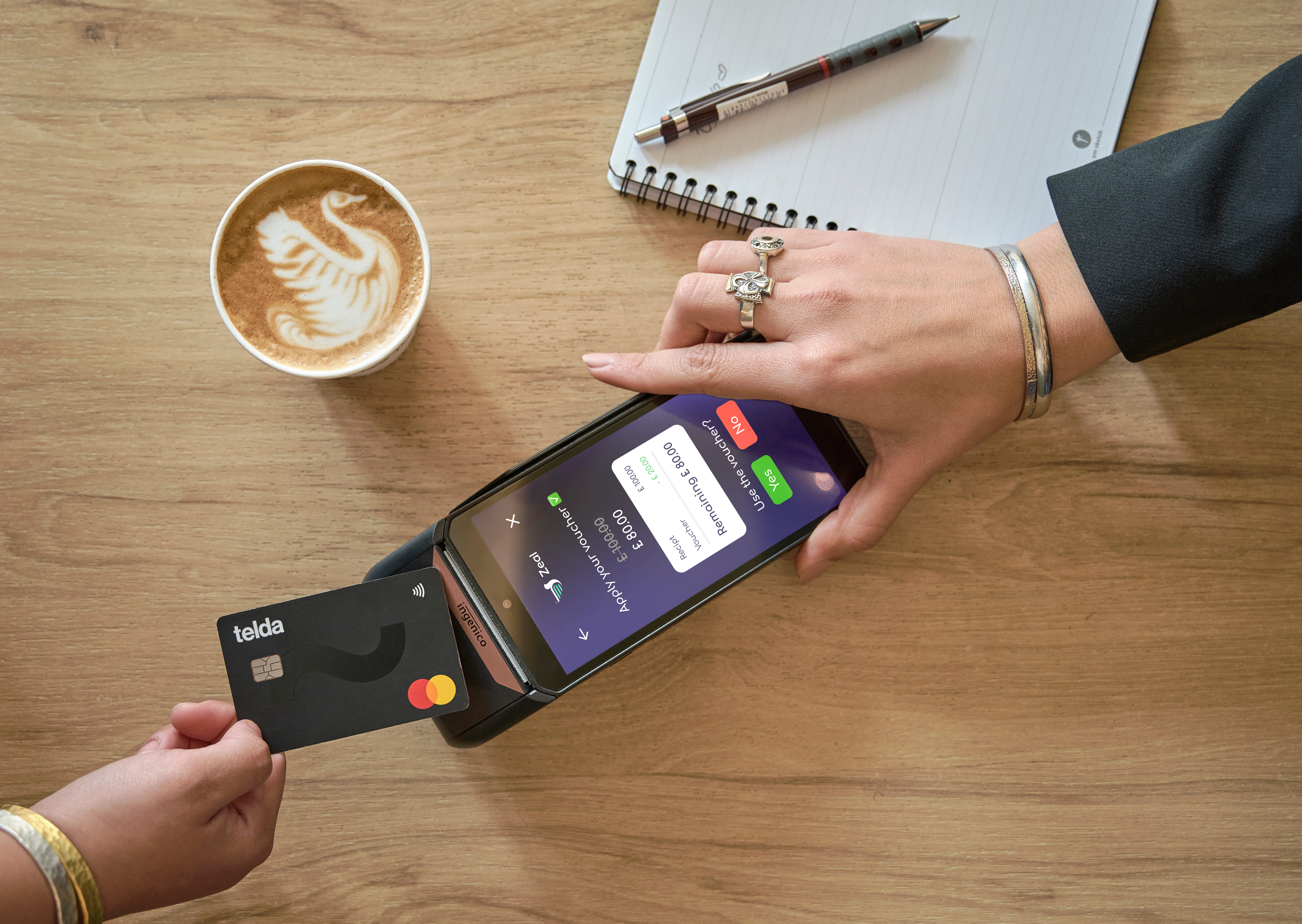
From the merchant's perspective, the terminal gains new functionality without changing the payment flow. The checkout process — tap, authorise, receipt — remains identical. Behind the scenes, the Zeal application captures the tokenised card data, associates it with the transaction, and transmits the pseudonymised record to the cloud analytics platform.
Merchants access insights through a web dashboard or API integration with their existing EPOS system. They see metrics like returning customer rate, visit frequency distribution, and cohort behaviour — all without knowing any individual's name or card number.
For ISOs considering how to differentiate their terminal proposition, this is a meaningful upgrade. The terminal becomes more than a payment device. It becomes a customer intelligence tool — and that changes the merchant's perception of the ISO's value.
Practical Applications: From Raw Identification to Commercial Outcomes
Identifying a returning customer is only valuable if something useful happens as a result. Here are the primary use cases that payment terminal customer identification enables.
Automatic Loyalty Accrual
The most immediate application. A customer earns loyalty points or stamps simply by paying with their usual card. No app required. No barcode scan. The terminal recognises the token, credits the loyalty account, and — on screen-equipped terminals — displays the updated balance on the receipt or terminal display. This passive enrolment model can increase loyalty participation rates significantly compared to traditional opt-in programmes, because it eliminates the primary barrier: the customer forgetting or choosing not to identify themselves.
Visit Frequency Analytics
Merchants can segment their customer base by visit frequency — daily regulars, weekly visitors, monthly occasionals, and lapsed customers. This segmentation drives targeted action. A coffee shop might offer a free pastry to a customer whose visit frequency has dropped from daily to weekly. A fashion retailer might send a seasonal preview invitation to high-frequency shoppers.
Cohort-Level Behaviour Analysis
Beyond individual identification, aggregated token data reveals patterns across customer cohorts. What percentage of customers acquired in January are still active in June? How does average transaction value change between a customer's first and fifth visit? These are questions that e-commerce teams answer routinely but that physical retailers have historically been unable to address.
Offer Targeting and Redemption Tracking
When a merchant issues a promotion — say, 20% off for returning customers — the terminal can automatically apply the discount when a qualifying token is detected. More importantly, it can track redemption rates with precision. No coupon codes. No cashier discretion. The offer is applied at the payment layer, and the analytics platform records whether the customer returned, what they spent, and whether their behaviour changed post-promotion.
Multi-Site Customer Movement
For merchants with multiple locations, token-based identification reveals cross-site behaviour. A gym chain discovers that 15% of its members regularly visit two branches. A restaurant group learns that customers who visit one brand are three times more likely to try a sister brand within 90 days. This intelligence is invisible without a persistent customer identifier.
Explore how Zeal's platform delivers these capabilities through its transaction intelligence features.
Limitations and Honest Trade-Offs
No identification system is perfect. Payment terminal customer identification has specific limitations that merchants and partners should understand before deployment.
One Card ≠ One Customer
A customer who pays with three different cards — personal debit, credit card, and a joint account card — will appear as three separate customers. Conversely, a shared business card used by multiple employees will appear as one. Card-based identification achieves roughly 70-85% accuracy in matching transactions to unique individuals, depending on the merchant category and customer payment habits. This is far better than zero identification, but it is not perfect.
Cash Transactions Are Invisible
Cash still accounts for approximately 14% of UK payments, per UK Finance data. These transactions cannot be identified at the terminal. In cash-heavy sectors — market stalls, certain convenience stores, some hospitality venues — the identification coverage will be lower.
Mobile Wallet Token Variability
Apple Pay, Google Pay, and Samsung Pay use Device Account Numbers (DANs) rather than the underlying card PAN. A customer paying with Apple Pay on their iPhone generates a different token than the same customer paying with their physical card. Some tokenisation schemes can link DANs to the underlying PAN token; others cannot. This is a technical nuance that affects accuracy and must be addressed during implementation.
Customer Perception
Even with full GDPR compliance, some customers may feel uncomfortable knowing their visits are tracked — even pseudonymously. Transparency is essential. Clear privacy notices, easy opt-out mechanisms, and a genuine commitment to data minimisation are not just legal requirements; they are commercial necessities. A merchant that loses customer trust over a loyalty programme has made a catastrophic trade-off.
Terminal Compatibility
As noted above, legacy terminals cannot run on-device applications. An ISO with a mixed fleet — some PAX A920s, some older Verifone VX520s — will have uneven coverage. Migration to Android-based terminals is accelerating across the UK market, but it is not yet universal.
Where This Fits in the Broader Payments Ecosystem
Payment terminal customer identification is not a standalone technology. It sits at the intersection of several converging trends in payments and retail.
The Terminal as a Platform
The shift from single-purpose payment terminals to multi-application smart terminals is well underway. Android-based devices from PAX, Castles, and Newland support app ecosystems that extend terminal functionality into loyalty, inventory, staff management, and marketing. Customer identification is the foundational layer that makes many of these applications meaningful. Without knowing who the customer is, personalisation is impossible.
ISO Differentiation Pressure
The ISO and acquirer market in the UK is intensely competitive. Processing margins are thin. Terminal hardware is commoditised. Value-added services — particularly those that generate measurable commercial outcomes for merchants — are the primary differentiation lever available to ISOs. Customer identification and the loyalty, analytics, and marketing capabilities it enables represent a category of VAS that directly ties the terminal to the merchant's revenue growth.
The Cookieless Future Arrives In-Store
Digital marketers are scrambling to replace third-party cookies with first-party data strategies. Physical retailers face the same imperative but with different tools. The payment terminal is the most universal touchpoint in physical retail — present in virtually every store, used in virtually every transaction. It is the natural anchor for in-store identity resolution, just as the browser was for online.
The retailers and payment distributors who recognise this earliest will build the deepest customer intelligence moats. Those who wait will find themselves competing on price alone — a race with only one outcome.
Getting Started: A Practical Checklist for ISOs and Merchants
For ISOs, acquirers, and merchants evaluating payment terminal customer identification, here is a practical framework for assessment.
StepActionKey Question
1. Fleet AuditInventory terminal models across the estateWhat percentage of terminals are Android-based and TMS-managed?
2. Privacy AssessmentConduct a Legitimate Interest Assessment or identify consent mechanismDoes the tokenisation method meet GDPR pseudonymisation standards?
3. PCI Scope ReviewConfirm that token generation occurs within the existing PCI-certified environmentAre token storage systems outside CDE scope?
4. Use Case PrioritisationIdentify the highest-value application — loyalty, analytics, or offer targetingWhich use case addresses the merchant's most urgent commercial gap?
5. Pilot DeploymentDeploy on a subset of terminals (e.g. 10-20 sites) to validate data quality and merchant experienceIs the token match rate acceptable given the merchant's payment mix?
6. Measurement FrameworkDefine KPIs — returning customer rate, loyalty participation, campaign attribution accuracy
How will success be measured after 90 days?
The most common mistake is deploying the technology before defining the use case. A merchant who activates customer identification without a loyalty programme, analytics dashboard, or marketing workflow to consume the data will see no benefit. The identification layer is infrastructure. The value sits in the applications built on top of it.
Zeal works with ISOs and acquirers to ensure both layers — identification infrastructure and commercial application — are deployed together. That alignment is what separates a technical capability from a merchant outcome.
Frequently Asked Questions
What is payment terminal customer identification?
Payment terminal customer identification is the process of recognising returning customers at the point of sale using tokenised card data from their payment transaction. Unlike Terminal IDs (TIDs), which identify the device, customer identification uses a cryptographic token derived from the card's Primary Account Number to build a pseudonymised profile that persists across visits and locations.
How does a payment terminal identify a customer without storing card numbers?
The terminal generates an irreversible cryptographic hash or requests a token from a Token Service Provider during the EMV transaction flow. This token cannot be reversed to reveal the original card number. It is stored and matched against previous tokens to recognise returning customers, while the raw PAN is never retained by the identification system.
Is payment terminal customer identification GDPR compliant?
Tokenised card identifiers are classified as pseudonymised personal data under GDPR, not anonymised data. Processing can be lawful under legitimate interest (Article 6(1)(f)) with a documented Legitimate Interest Assessment, or under explicit consent. Transparency, data minimisation, and an easy opt-out mechanism are essential requirements for compliance.
What is a terminal ID (TID) in POS?
A Terminal ID (TID) is a unique eight-digit numeric code assigned by the acquirer or payment processor to identify a specific point-of-sale device. It is used for transaction routing, reconciliation, and chargeback tracing. A TID identifies the machine, not the customer making the payment.
Which payment terminals support on-device customer identification software?
Modern Android-based terminals such as the PAX A920, Castles S1F2, and Verifone T650c support third-party application installation via Terminal Management Systems. Legacy terminals running proprietary real-time operating systems, such as the Verifone VX520, generally cannot host on-device identification software.
Does card-based customer identification work with Apple Pay and Google Pay?
Mobile wallets use Device Account Numbers (DANs) rather than the physical card's PAN, which means a customer paying via Apple Pay may generate a different token than when using their physical card. Some tokenisation schemes can link DANs to the underlying card token, but this varies by implementation and should be validated during deployment.
You might also like