What Are Value-Added Services on Payment Terminals?
Learn what payment terminal value-added services are, how they fit into the payments stack, who deploys them and how to evaluate a VAS model.

Direct answer: Payment terminal value-added services are controlled applications or services delivered alongside card acceptance to create additional value for merchants, customers or payment partners. They can support customer engagement, digital receipts, operational tools, analytics and other approved journeys. They do not replace the certified payment application, alter settlement or gain unrestricted access to sensitive payment data.
What counts as a payment terminal value-added service?
A payment terminal value-added service, or VAS, is a capability delivered through or around a payment terminal that is additional to the core acceptance, authorisation, clearing and settlement of a payment. It may use the terminal screen, printer, scanner or approved software interfaces, but only within the permissions established for the device, payment application, acquirer or processor route and deployed build.
This definition has three important parts:
- It adds value beyond payment acceptance. The service should solve a merchant, customer or partner problem that basic card acceptance does not solve on its own.
- It operates within a controlled payment environment. A smart payment terminal is not an unrestricted consumer tablet. Application permissions, payment data access, distribution and updates are governed.
- It remains separate from the regulated payment responsibilities around it. A VAS application does not become the payment application, acquirer, processor or settlement system merely because it runs on the same device.
The category is therefore broader than a single feature such as rewards. It is also narrower than every service sold by a PSP. A merchant loan, for example, may be a value-added service in a PSP’s commercial portfolio without being a payment terminal VAS unless the terminal is part of the customer journey or delivery mechanism.
Which categories belong in a terminal VAS taxonomy?
A useful taxonomy classifies each service by the job it performs, the data it needs and the operational owner required to support it. This is essential for centralised management for multi-vendor payment terminals, ensuring compatibility and efficiency.
Customer engagement services
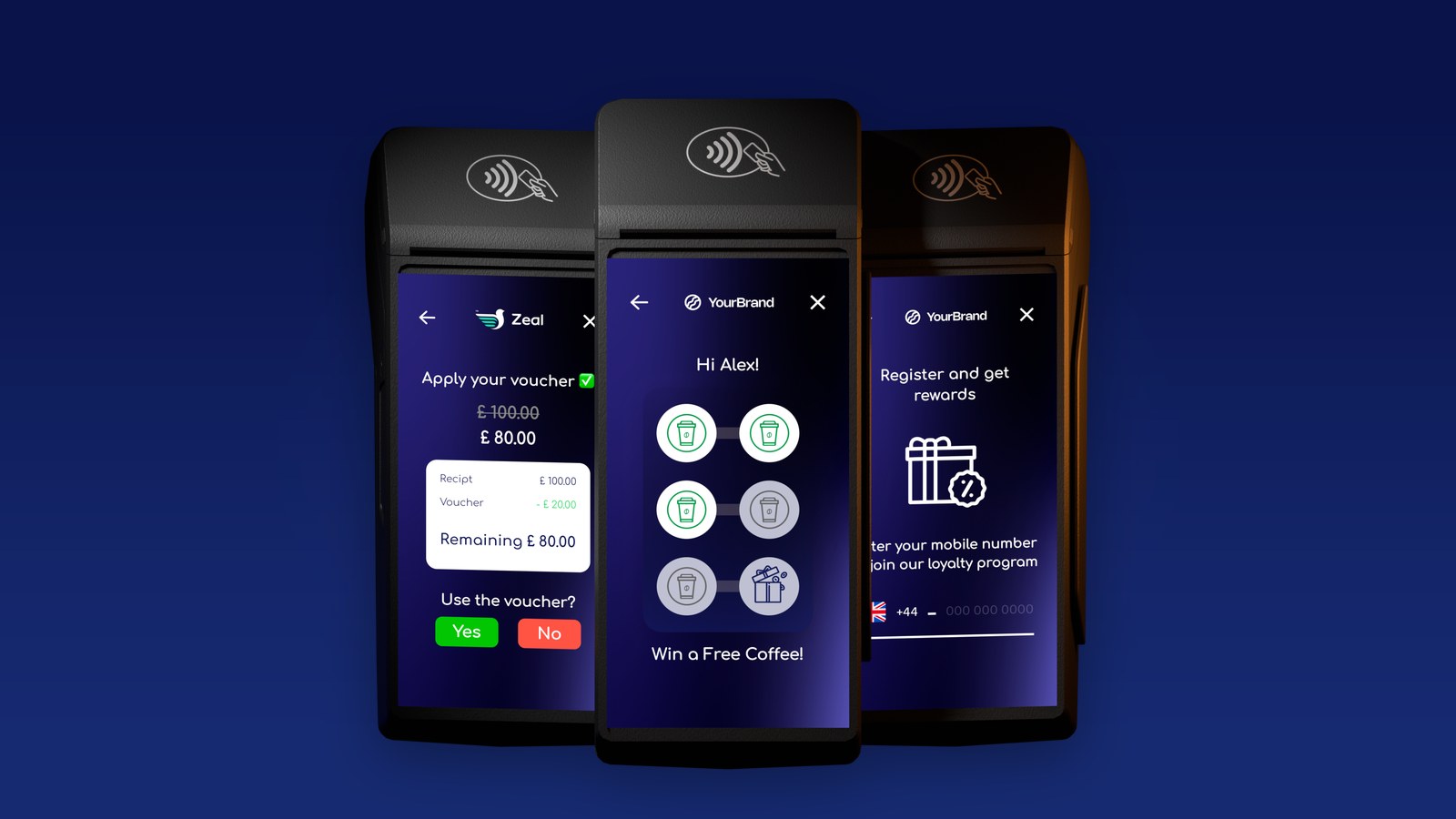
These services use an approved terminal journey to support enrolment, recognition, rewards, offers, feedback or another customer interaction. Identification may use an account, QR code, barcode or controlled token, subject to the design approved for the specific payment environment. Payment credentials should not be treated as unrestricted customer identifiers.
Receipt and post-payment services
Digital receipts, receipt preferences and post-payment messages can reduce paper use or connect a completed transaction to a merchant service journey. Receipt content is not a free-form marketing surface. Scheme-required and certified receipt data must remain intact. Adyen’s receipt guidance explains that an EPOS application can print, display or email prescribed receipt data, while changes to certified data can create scheme-compliance and chargeback risk.
Merchant operations services
A terminal may support approved applications for staff workflows, order handling, stock-related prompts, site information or service requests. Whether a capability is practical depends on available peripherals, device policy, connectivity, application distribution and the division of responsibility between the merchant’s EPOS environment and the terminal.
Analytics and reporting services
A VAS layer can turn permitted transaction references and non-sensitive operational context into merchant reporting or estate-level insight. The design should begin with a data dictionary: which fields are generated by the VAS, which come from the payment application, which are personal data, how long they are retained and which party is accountable for each use.
Commerce and social-impact journeys
Approved prompts can support offers, charitable giving or other merchant-selected experiences before or after payment. These journeys require careful attention to consent, customer comprehension, screen order and any scheme or acquirer rules. A terminal screen should not create ambiguity about whether the customer is paying the merchant, making a separate contribution or accepting marketing.
Financial and payment-adjacent services
Some payment-adjacent products are marketed within wider VAS portfolios, but their stack position differs. Dynamic currency conversion is an acquiring or payment-application function governed by scheme and acquirer rules; instalments and cash advances may be regulated financial products. None should be classified as an ordinary third-party terminal application without deployment-specific evidence. The responsible provider, disclosures, pricing, eligibility and scheme or regulatory requirements must remain explicit.
The correct taxonomy is not a feature wish list. It is a control tool. Each proposed service should be mapped to its user, data inputs, terminal permissions, commercial owner, compliance owner and measurable outcome.
How do value-added services fit into payment-terminal architecture?
Payment terminal VAS sits between merchant experience design and a tightly controlled payment stack. The safest architecture separates the layers rather than assuming one supplier owns everything.
- Hardware and platform layer. The terminal manufacturer provides the device, firmware, operating environment and supported peripherals. Device approval is configuration-specific, not a blanket guarantee that every application will work on every model.
- Certified payment layer. The EMV kernel and payment application handle protected transaction states, cardholder verification and host messaging. EMVCo’s Level 3 guidance explains that end-to-end testing covers the interaction among an approved terminal, payment application, merchant, acquirer or processor and payment-network infrastructure.
- Controlled integration layer. Documented interfaces let an EPOS application or approved on-device application request payment and receive permitted results. J.P. Morgan’s terminal application documentation distinguishes semi-integrated operation from an on-device model where control passes to the protected payment application for payment.
- VAS application and orchestration layer. The VAS controls its own approved prompts, rules, configuration and service data. It should consume only the minimum permitted payment or basket context needed for the stated purpose.
- Distribution and estate-management layer. A terminal management system, or TMS, may install applications, update configuration, report versions and support staged rollouts. Remote key injection is a separate cryptographic capability, even when offered through the same operating environment. This is vital for centralised management for multi-vendor payment terminals.
- Merchant systems layer. EPOS, CRM, data platforms and back-office tools may exchange approved information with the VAS. These integrations require identity, consent, retention and support rules of their own.
- Acquiring and settlement layer. Merchant boarding, routing, scheme messages, clearing and settlement remain governed by the acquirer or processor configuration. Where the approved interface and permissions allow it, a VAS may receive a limited transaction result or reference without controlling authorisation, clearing or settlement; the fields and timing are configuration-specific.
This layered model explains why “runs on Android” is not evidence of production readiness. Stripe’s applications-on-devices documentation shows that a supported Android application can be deployed to specified readers while production capabilities such as debugging, system controls and non-payment NFC are restricted. The exact boundary varies by estate.
What can a VAS application do, and where are the boundaries?
A correctly designed VAS may display an approved customer prompt, accept a non-sensitive selection, use a permitted scanner or printer, pass an amount to the protected payment application, receive a controlled result and send service data to an authorised merchant system. myPOS’s Smart SDK documentation provides one public example in which a third-party application can initiate payment and use permitted peripherals without receiving or storing sensitive cardholder data.
A VAS should not:
- capture PIN, PAN, track data, cryptograms or authentication values;
- replace or imitate the certified payment interface;
- use payment NFC for an unrelated purpose where the platform reserves it;
- alter scheme-required receipt fields;
- inject or manage payment keys outside an approved process;
- assign MIDs or TIDs, board merchants or control transaction routing;
- determine clearing, funding or merchant settlement;
- assume that one approval covers every firmware, kernel, payment application, acquirer, scheme, country and feature combination.
The security boundary involves several standards rather than one certificate. PCI Security Standards Council’s standards overview distinguishes device protection, PIN and key management, payment software, secure software development, point-to-point encryption and PCI DSS obligations. A PTS-approved terminal alone does not prove that a VAS architecture reduces the wider merchant environment’s PCI DSS scope.
Tokenisation also needs precise language. EMVCo’s payment tokenisation overview explains that a payment token can be restricted to a merchant, device or payment scenario. Tokenisation, transport encryption and a validated point-to-point encryption solution address different risks. None of them gives a VAS permission to use a payment credential for an unrelated purpose.
Who is responsible for deploying and operating terminal VAS?
Deployment succeeds when responsibilities are assigned before development begins.
- The terminal manufacturer owns the hardware, firmware, platform controls and relevant device approvals.
- The Payment App Vendor commonly owns or supports the signed payment build, kernel interface, transaction-state handling, host messaging, release lifecycle and certification artefacts. Contractual allocation varies.
- The acquirer or processor commonly owns merchant boarding, acquiring connectivity, scheme routing, commercial rules and settlement configuration.
- The PSP deploys the approved software into its estate and coordinates merchant enablement, operational support and commercial packaging.
- The ISO distributes or services the proposition where that is its contracted role. An ISO should not be described as the deploying party without evidence that it controls deployment.
- The TMS operator manages authorised application packages, configurations, versions, cohorts, rollback and estate telemetry within its scope.
- The VAS provider owns the approved service application, its business logic, service data, configuration and support commitments.
- The merchant owns local operating procedures, staff readiness and its responsibilities for customer notices, permissions and data use.
One organisation may combine several roles, but the responsibility matrix should still keep them separate. The contract should identify who approves a release, who can push it, who can stop or roll it back, who handles a failed transaction journey, who investigates a data incident and who communicates with the merchant.
How should PSPs deploy VAS across a terminal estate?
A controlled rollout is normally safer than a universal enablement claim.
Phase 1: prove compatibility and responsibility
Build an estate inventory covering terminal model, OS, firmware, kernel, payment-application version, VAS version, TMS profile, merchant or store, MID and TID associations, acquirer route and country. Confirm the approved interface, data fields, receipt rules, certification path and support matrix. Define what evidence is required before a device cohort is eligible.
Phase 2: pilot a bounded merchant cohort
Choose a small cohort that represents the intended production estate rather than only the easiest devices. Establish success, failure and rollback criteria before deployment. Measure technical stability, merchant adoption, customer completion, support demand and any operational effect separately. Do not present an observed correlation as a causal retention or revenue result without an appropriate comparison design.
Phase 3-4: scale, monitor and govern
Use staged cohorts, version control and rollback capability. Monitor installation, application health, configuration drift, transaction-journey failures and support cases. Maintain a current responsibility matrix and certification record as firmware, payment applications, acquirer profiles or VAS features change. A successful pilot does not prove compatibility across the remaining estate.
Which commercial models can support terminal VAS?
The commercial model should reflect who receives value, who deploys and supports the service, and which costs rise with estate size or usage.
Common structures include:
- Per-terminal subscription: a recurring fee for each enabled terminal, useful where device-level distribution and support are the cost drivers.
- Per-merchant or per-site subscription: a recurring fee linked to an operating location or merchant account, often clearer for multi-terminal sites.
- Usage-linked fee: a fee based on an approved service event such as a receipt or redemption, provided the event is consistently defined and auditable.
- Portfolio licence: a minimum commitment or estate licence covering an agreed scope, with rules for additions, removals and inactive devices.
- Bundled merchant proposition: VAS included within a broader PSP package. The bundle still needs an internal contribution model so the service is not mistaken for zero-cost functionality.
- Partner revenue share: an agreed division of service revenue among contracted parties. The basis, deductions, refunds, tax treatment, reporting and audit rights must be explicit.
Public payments-company reporting supports the existence of several revenue pools without establishing one best model. Global Payments’ FY2025 filing states that software, subscription, licence and VAS fees can be independent of transaction value or count. The US Office of the Comptroller of the Currency’s merchant-processing handbook describes merchant processing as high-volume and low-margin and lists service, equipment and other fee categories. Neither source proves a universal VAS margin, price or merchant-retention effect.
The decision should be based on net contribution, not headline revenue. Include integration, certification, TMS, support, hardware, sales compensation, partner share, refunds, losses and ongoing compliance costs on a consistent basis.
Which VAS approach should a payment leader choose?
Use the table below as a decision gate, not a vendor ranking.
- Merchant problem
- Evidence required before approval: Named user, current workflow and measurable outcome
- Warning sign: Feature selected because the terminal can display it
- Preferred decision rule: Fund only a problem with an accountable merchant owner
- Estate compatibility
- Evidence required before approval: Device, firmware, payment-app, TMS and acquirer matrix
- Warning sign: Estate-wide support asserted without configuration evidence
- Preferred decision rule: Approve only documented eligible cohorts
- Payment boundary
- Evidence required before approval: Interface specification and responsibility matrix
- Warning sign: VAS is assumed to access payment data or settlement
- Preferred decision rule: Keep protected payment functions inside approved owners
- Data and privacy
- Evidence required before approval: Field-level data map, purpose, lawful basis, retention and deletion
- Warning sign: Payment consent is reused for marketing
- Preferred decision rule: Require purpose-specific governance before live use
- Deployment control
- Evidence required before approval: Signed package, certification path, staged release and rollback
- Warning sign: One-step estate-wide push with no cohort controls
- Preferred decision rule: Pilot, observe, then scale by controlled cohort
- Merchant support
- Evidence required before approval: Owner for training, incidents, updates and exits
- Warning sign: Support responsibility is split informally
- Preferred decision rule: Put response and escalation duties in contract
- Commercial model
- Evidence required before approval: Net-contribution bridge and auditable billing unit
- Warning sign: Revenue share defined before deductions or refunds
- Preferred decision rule: Model value and cost by merchant segment
- Proof of value
- Evidence required before approval: Baseline, success metric and comparison method
- Warning sign: Unsupported churn, revenue or repeat-visit promise
- Preferred decision rule: Publish only outcomes supported by approved evidence
What should be checked before signing or launching?
- Define the service and the merchant problem in one sentence.
- Identify the exact terminal, firmware, payment application, acquirer route and market in scope.
- Confirm which interface and data fields the VAS may use.
- Map the terminal manufacturer, Payment App Vendor, acquirer or processor, PSP, TMS operator, VAS provider, ISO and merchant responsibilities.
- Confirm EMV, PCI, scheme, acquirer and privacy requirements for the exact configuration.
- Specify signing, application distribution, configuration, rollback and support procedures.
- Define the billing unit, contribution bridge, partner deductions and audit rights.
- Establish a pilot baseline, success criteria and evidence standard.
- Document the exit process, including application removal, data return or deletion and merchant continuity.
- Reapprove material changes to firmware, payment application, integration, acquirer profile or service purpose.
If any answer is “all devices”, “all acquirers” or “the platform handles it”, the scope is probably not precise enough for production approval.
How does Zeal fit the category without defining it?
Zeal is a reference implementation of the VAS category, not the category itself. Zeal sits alongside the payment stack to help approved services reach supported payment-terminal estates while the terminal manufacturer, Payment App Vendor, PSP, acquirer or processor and merchant retain their respective responsibilities. Zeal's offerings also enable centralised management for multi-vendor payment terminals, enhancing operational efficiency.
This position matters because a VAS provider should not be mistaken for the core device software, payment application, processor or settlement owner. Nor should the category be reduced to one customer-engagement feature. Any Zeal deployment claim must still be verified against the exact terminal, software, partner, market and contracted responsibility matrix before external use.
Frequently asked questions
Are payment terminal value-added services part of payment processing?
They are adjacent to processing but are not the same function. A VAS may request the protected payment application to take payment or receive a permitted result, yet authorisation, scheme messaging, clearing and settlement remain within the certified payment and acquiring stack. Contracts and architecture should preserve that separation even when one provider supplies several layers.
Can any application run on a smart payment terminal?
No. Smart payment terminals are controlled appliances. Supported frameworks, permissions, signing, app-store or TMS distribution, network access and peripheral use vary by device and production environment. Compatibility must be proven for the exact terminal, firmware, payment application, acquirer route, country and deployed build rather than inferred from the underlying operating system.
Does a VAS application need PCI DSS certification?
There is no single yes-or-no answer for every application. Scope depends on architecture, data flows, deployment and contractual responsibilities. PCI standards cover different layers, including devices, PIN and key management, payment software, secure development, encryption and the wider environment. A qualified assessor and relevant partners should confirm the exact scope.
Can a VAS use a card token to identify a customer?
Only where the token, purpose, permissions and privacy design support that use. Payment tokens may be restricted to a merchant, device or scenario and may fragment across wallets or credentials. A token should not automatically be treated as a stable person identifier. Explicit member identification can be more dependable for cross-channel journeys.
Who deploys terminal VAS, a PSP or an ISO?
The PSP deploys the approved software and coordinates enablement for its terminal estate. An ISO typically distributes or services the merchant proposition unless its contract and technical control establish a different role. The Payment App Vendor, TMS operator and acquirer or processor still need to approve or perform their allocated parts of the release.
How should VAS ROI be measured?
Start with a defined merchant outcome and a consistent net-contribution bridge. Compare an agreed baseline or control with the live cohort, separate adoption from technical availability, and deduct integration, certification, support, TMS, partner and compliance costs. Do not use a universal churn or revenue uplift without evidence from the relevant estate and period.
Source note
This article reflects public information available as at 8 August 2026. Technical capabilities, certifications, permissions, data flows and responsibilities vary by terminal, firmware, payment application, acquirer or processor, scheme, market and contracted deployment. Cited provider documentation illustrates specific implementations and does not imply a Zeal integration, partnership or commercial relationship with any provider named.
What is the next step for a terminal VAS strategy?
Start with one merchant problem and one eligible terminal cohort, then build the responsibility, certification, data and commercial evidence around it. To assess where Zeal may fit within that controlled deployment model, contact Zeal.
You might also like