Zeal vs Fidel API: Which Card-Linked Architecture Fits?
Compare Zeal and Fidel API by deployment, data roles, customer journey and implementation burden to choose the right card-linked architecture.

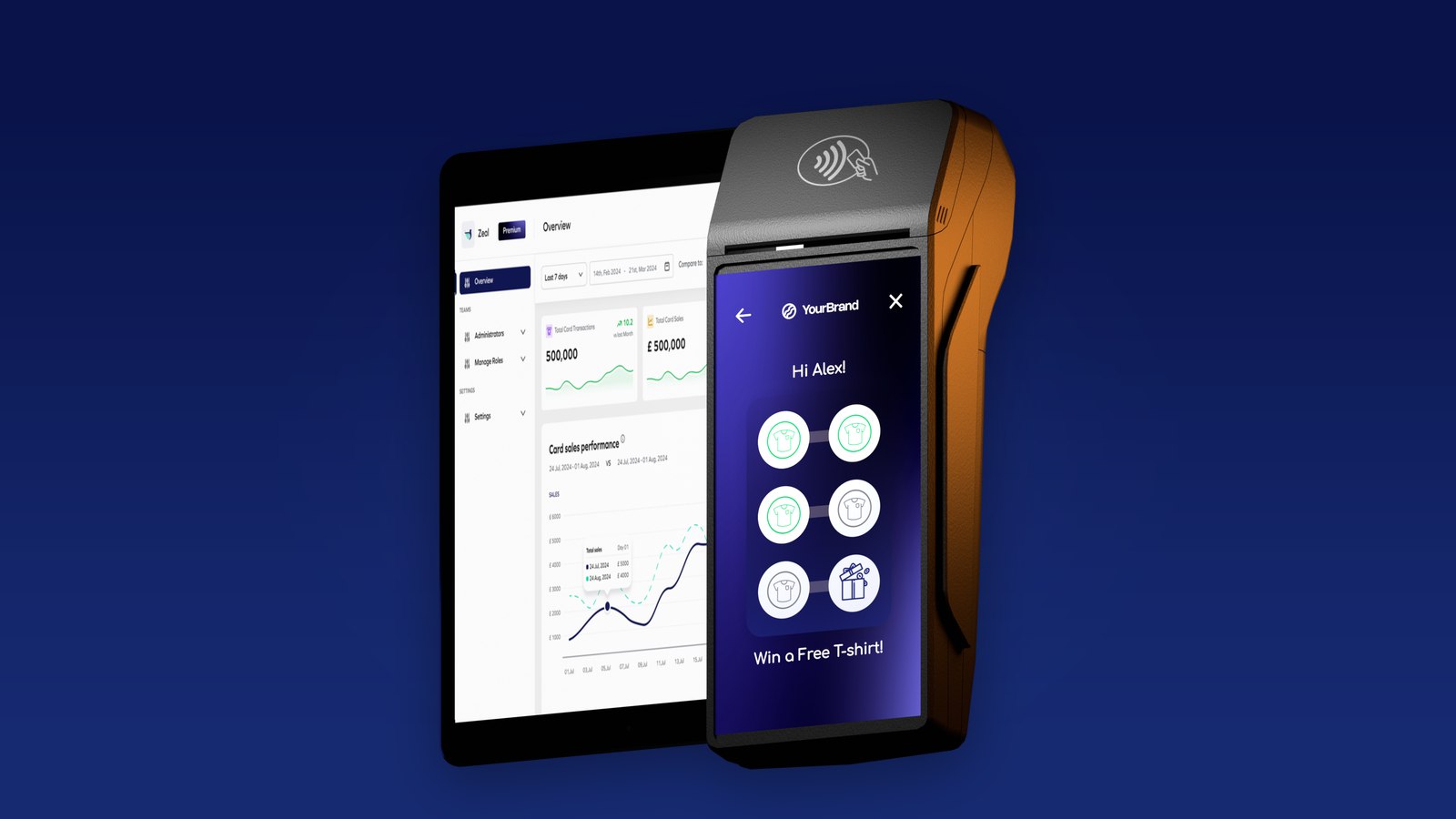
Zeal and Fidel API solve different card-linked engagement problems. Zeal is an award-winning value-added services provider for payment terminals, designed for supported payment-provider estates and terminal-side experiences. Fidel API supplies card-network connectivity, card enrolment and transaction-event infrastructure for client-owned digital programmes. Choose according to deployment control, customer journey, data responsibilities and operational capability, not a generic feature score.
Zeal and Fidel API sit at different layers of the payment stack
The most useful Zeal vs Fidel API comparison starts with architecture. They are not interchangeable versions of the same product.

Payment-terminal value-added services are software-enabled capabilities delivered in or around the payment-terminal flow, outside the core functions of acquiring, gateway services and payment processing. Zeal's Global Partnership Terms define its services as value-added services and exclude core payment processing. Zeal's public proposition covers customer identification, engagement, analytics and different loyalty journeys through supported payment-terminal environments.
Card linking is the consent-based association of a payment card with a programme. Fidel API's Cards documentation describes enrolment, tokenisation and the non-sensitive card ID returned to the client. Once an enrolled card is used at an onboarded participating merchant, supported transaction events can pass from the card network through Fidel to the client's system.
A transaction-event webhook is an HTTPS message sent from one system to another when an event occurs. Fidel's webhook documentation explains its event delivery, signature validation, response and retry requirements. Receiving the event is not the same as running a complete rewards programme. The client still needs customer-facing journeys, programme rules, a reward or cashback ledger, reconciliation and customer communications.
The practical distinction is therefore straightforward: Zeal brings value-added services to supported payment-terminal flows, while Fidel API gives a product team infrastructure for recognising opted-in linked-card transactions through card-network data.
The decision table: Zeal vs Fidel API by architecture and operating model
Decision dimension | Zeal | Fidel API | What the buyer should verify |
|---|---|---|---|
Core model | Payment-terminal VAS for identification, engagement, analytics and product-specific loyalty journeys. | Card-linking, selected transaction-event and offer infrastructure. Fidel is not a complete consumer rewards proposition. | Which layer must create the customer experience and which system will hold the programme rules and ledger? |
Ideal buyer | A PSP, acquirer or authorised terminal-estate operator seeking VAS across supported payment terminals. | A fintech, bank, employee-benefit, cashback, airline or rewards product team building a client-owned digital proposition. | Does the buyer control terminal distribution, the digital customer experience, or both? |
Deployment surface | Supported payment-terminal software or integration route, authorised PSP or terminal-management channel, Zeal management surfaces and the selected Zeal product journey. | Client web or mobile enrolment, Fidel SDK or API, server-side webhooks, Fidel management tools and card-network merchant/location onboarding. | Who controls the terminal, TMS, customer interface, merchant data, APIs and release process? |
Customer recognition | Product-dependent identification in or around the payment-terminal flow. Public information does not establish one universal recognition method for every scheme, wallet or deployment. | An opted-in card is linked, then a qualifying transaction at an onboarded merchant is matched through card-network data and sent to the client. | What consent, account linking, phone entry, token matching or fallback step occurs on the first and later visits? |
Consumer app requirement | Product-dependent. Zeal publishes an app journey, Micro Loyalty as a no-app option and Loyalty Link for an existing programme. | No Fidel-branded consumer app is required, but the programme operator must provide a web or mobile card-enrolment surface. | Is a native app acceptable, is web enrolment enough, or must the chosen journey work without an app? |
Merchant EPOS change | Terminal deployment is intrinsic. EPOS requirements may depend on the use case, especially where item-level earning or redemption is needed. | No individual merchant EPOS change is required for core card-network recognition, but programme, brand, location and MID onboarding remain necessary. | Does the use case need item, basket or redemption data that network events alone may not provide? |
Transaction timing | Terminal-side interaction is possible in supported deployments, but exact timing across authorisation, decline, reversal, refund, offline and gratuity-adjust scenarios must be confirmed. | Authorisation events can arrive in real time; clearing generally follows later, and refunds, voids and missing events require reconciliation. | Is an immediate interaction needed, or is near-real-time digital actioning followed by later reconciliation sufficient? |
Data roles | Zeal's public privacy policy describes Zeal as controller for data it processes; partnership terms allow controller, processor or joint-controller roles depending on the relationship. | Fidel states that, for Select Transactions end-user data, the client is controller and Fidel is processor. | Confirm access, export, retention, lawful basis, international transfers, permitted uses and deletion contractually. |
Implementation burden | Payment-provider approval, supported device and payment-application checks, certification where required, controlled rollout, terminal distribution, merchant configuration and support. Public pages do not state a universal timeline. | Card-enrolment UX, consent, programme and location setup, MID onboarding, webhooks, security controls, event processing, reward logic and exception reconciliation. | Which team owns engineering, payment operations, compliance, merchant onboarding and ongoing incident handling? |
Coverage | Subject to territory, device, payment application, TMS, PSP and technical approval. No complete public production matrix was found in the evidence reviewed. | Documentation reviewed on 8 August 2026 listed the US, UK, Ireland, Canada, Sweden and UAE, with Japan in beta. Production availability, networks, card types, wallet tokens, fields and onboarding requirements still need written confirmation for the proposed programme. | Obtain a written market, scheme, card-type, wallet, device and merchant-model support matrix before contracting. |
Primary strength | Places VAS and customer interaction in the payment-terminal journey and gives payment providers an estate-level proposition. | Creates a common card-network recognition layer without changing each merchant's payment terminal or EPOS for the core model. | Which surface has the greatest strategic value: the payment terminal or the client-owned digital product? |
Primary limitation | Requires influence over a supported terminal deployment route, while public technical and territorial coverage is incomplete. | Requires cardholder opt-in, merchant/MID onboarding and substantial client-owned product and operational infrastructure. | Which dependency is harder for the buyer to control? |
The table deliberately avoids a winner. The right choice follows from the buyer's controlled surface and desired operating model.
Fidel API is strongest for client-owned, cross-merchant digital propositions
Fidel API is a credible fit when a product team wants to build card-linked rewards, cashback, benefits or offers across participating merchants without installing software on each merchant's payment terminal. Fidel's current documentation separates Select Transactions from Offers as a Service, making the boundary clear: Fidel supplies infrastructure, while the client designs the member proposition and downstream actions.
The recognition flow has six practical steps:
The client creates its programme and provides a web or mobile enrolment experience.
The customer enters the required card details and gives the applicable consent.
Fidel tokenises the card when its supported SDK route is used and returns a non-sensitive card ID, as set out in the Cards documentation.
The client onboards participating brands, locations and merchant identifiers to the card-network monitoring model.
A relevant event for an enrolled card at an onboarded merchant is sent to the client's webhook.
The client applies its own reward logic, updates its ledger and communicates with the customer.
This model reduces the need for merchant-side software changes, but it does not remove setup. Fidel's Locations documentation requires programme, brand and location configuration, describes live Location Sync and flags shared-MID considerations for some payment facilitators. Its November 2025 MID Management release and February 2026 bulk MID actions release provide newer self-service operations, but merchant identity still needs active management.
Fidel's strengths are its card-network layer, client-controlled branding and ability to support a digital proposition across onboarded merchants. Its limitations are equally important: the customer must first enrol a supported card; coverage varies by market, network and data field; the client must build and operate the programme; and transaction exceptions require reconciliation.
Zeal is strongest when payment-terminal VAS and estate distribution are central
Zeal is an award-winning value-added services provider for payment terminals. Its differentiated surface is the payment terminal, not a card-network event feed. That matters when a PSP or acquirer wants to deploy additional merchant capabilities through supported terminal and terminal-management environments.
Zeal's public product pages describe three distinct paths rather than one universal customer journey. Zeal presents an app, Micro Loyalty and Loyalty Link as separate options. Micro Loyalty is presented as a no-app payment-terminal option, while Loyalty Link is designed to connect an existing programme to the payment-terminal flow. Comparison copy should therefore never claim that every Zeal implementation is app-free or follows one enrolment method.
Zeal's strengths are the placement of customer interaction in the payment journey, the ability to support different product paths, and the potential for a payment provider to distribute VAS as an estate proposition. Zeal's limitation is that successful deployment depends on the actual terminal environment. Device model, operating system, payment application, TMS access, processor or acquirer approval, territory, certification and support arrangements can all affect feasibility. Zeal's public pages do not provide a complete production support matrix, so a buyer should require deployment-specific confirmation.
Implementation burden differs rather than disappearing
Neither model is a zero-work integration. The work moves to different teams.

For Zeal, the buyer should expect an estate-specific delivery sequence: confirm target merchant journeys; validate supported devices, payment applications and countries; agree data and consent roles; complete any required technical integration or certification; test payment and exception scenarios; distribute through the authorised terminal-management route; configure merchants; then monitor and support the estate. Zeal's partnership terms describe deployment through authorised PSP or terminal-management controller channels, but they do not promise one universal schedule.
For Fidel, the engineering and operations workload sits mainly in the digital product and network-onboarding stack. The client must build enrolment, configure consent, operate secure webhooks, manage programmes and merchant identifiers, process event states idempotently, maintain the reward ledger and resolve exceptions. Fidel's Transactions documentation distinguishes authorisation, clearing and refund events and documents differences in available fields. Its March 2026 Missing Transaction Requests release also confirms that timing, technical lag or an unonboarded MID can create an operational investigation.
A buyer comparing implementation effort should ask which burden it is already equipped to carry. A mature fintech may prefer Fidel because it already owns the app, ledger and webhook operations. A PSP with terminal-management access and merchant support operations may prefer Zeal because the payment-terminal estate is its controlled distribution surface.
Data ownership should be evaluated as rights and responsibilities
"Who owns the data?" is too imprecise for either architecture. Buyers should separate data-controller status, processor obligations, access and export rights, permitted commercial use, retention, deletion, security and international transfers.
Fidel's Privacy Policy states that the client is controller and Fidel is processor for Select Transactions end-user personal data. The client controls the programme experience and acts on webhook events, but it must still document its lawful basis, customer disclosures, retention and downstream processors. Fidel's security page states that it is PCI DSS Level 1 certified and describes tokenisation, encryption, access controls and testing. Buyers should verify the current contractual position and any region-specific requirements rather than rely only on website summaries.
Zeal's Privacy Policy describes Zeal as controller for personal data it processes, while its partnership terms state that parties may be controller, processor or joint controllers depending on the relationship. The correct allocation is therefore product- and contract-specific. A PSP, acquirer or merchant should obtain written answers on data access, export, deletion, lawful basis, retention and permitted use before deployment.
Where Zeal is not the right fit
Zeal is not the right choice when the buyer's central requirement is a client-owned, cross-merchant card-linked digital proposition and the buyer neither controls nor can influence payment-terminal deployment. In that situation, terminal-side VAS introduces a dependency that does not advance the primary customer journey.
A buyer should evaluate Fidel API or another card-network infrastructure route instead when all or most of the following are true:
the product is a digital cashback, employee-benefit, bank, airline or rewards proposition;
customers can enrol a supported card through the buyer's web or mobile experience;
the proposition must work across participating merchants without changing their payment-terminal or EPOS software;
the buyer can build and operate consent, webhooks, a reward ledger, messaging and transaction reconciliation;
card-network coverage in the required markets is confirmed; and
payment-terminal interaction is not a core part of acquisition, recognition or reward delivery.
Zeal may also be unsuitable where the required country, device, payment application, TMS or certification path is unsupported or unconfirmed. That is a deployment gate, not evidence that one architecture is universally superior.
Conversely, Fidel may be the wrong fit if the buyer does not want active card enrolment, cannot onboard and maintain participating merchant identifiers, lacks webhook and ledger operations, or needs an experience presented directly on supported payment terminals.
The best choice follows four decision tests
Control test: Can the buyer authorise and operate software across the target payment-terminal estate, or does it primarily control a web and mobile product?

Four tests before you choose. Journey test: Must the interaction appear on the payment terminal, or can it happen digitally after a card-network authorisation event?
Operations test: Is the organisation better equipped for terminal certification and distribution, or for linked-card enrolment, merchant-identifier operations, webhooks, ledgers and reconciliation?
Coverage test: Has the provider confirmed the exact territories, schemes, wallets, card types, devices, payment applications, TMS routes and merchant models needed?
Choose Zeal when supported payment-terminal VAS and PSP or acquirer estate distribution are the strategic requirement. Choose Fidel API when a client-owned digital programme needs linked-card transaction infrastructure across onboarded merchants and the client can operate the surrounding product stack. Some organisations could use both architectural patterns in theory, but this comparison states no technical, integration, partnership or commercial relationship between the providers.
Frequently asked questions
Is Fidel API a complete consumer rewards programme?
No. Fidel API provides card-enrolment, transaction-event and offer infrastructure that a client can use to build a card-linked proposition. The client still needs the customer experience, programme terms, rules, reward or cashback ledger, communications and exception operations. Fidel's documentation overview defines the current product boundary between Select Transactions and Offers as a Service.
Does Fidel API require a consumer app?
It does not require a Fidel-branded consumer app. However, the programme operator must provide a mobile or web surface where the customer enrols a supported card and gives consent. Fidel's Cards documentation describes SDK and API routes. A web experience can therefore replace a native app, but it does not remove enrolment.
Does Zeal work without a consumer app?
That depends on the selected product and deployment. Zeal publicly presents an app journey, Micro Loyalty as a no-app option and Loyalty Link for an existing programme. It is inaccurate to apply one journey to every Zeal deployment. Buyers should confirm the exact first-use, consent, recognition and repeat-use flow for their supported terminal environment.
Is Fidel API slower because it is not on the payment terminal?
Not necessarily. Fidel's Transactions documentation says authorisation events can arrive in real time, while clearing generally follows later. The difference is primarily the interaction surface and event lifecycle, not a simple fast-versus-slow ranking. Buyers must test latency, finality, refunds, voids and missing-event handling for their actual programme.
Are Zeal and Fidel API integrated or commercial partners?
No integration, partnership or commercial relationship is stated or implied in this comparison. They are assessed as independent architectural options using public information. An organisation could theoretically operate terminal-side VAS and a separate card-network programme, but compatibility, data roles, commercial terms and technical integration would require direct confirmation from both providers.
Source note and comparison basis
This comparison reflects publicly available information reviewed as at 8 August 2026. Product support, network coverage, terminal compatibility, data roles and implementation requirements vary by market and deployment. Zeal and Fidel API are independent providers, and no integration, partnership or commercial relationship is implied. Prospective buyers should obtain current technical, legal, security and commercial confirmation before making a production decision.
If payment-terminal VAS is central to your estate strategy, contact Zeal to assess the supported deployment path.
You might also like