Loyalty Cards for Small Businesses: Paper, Digital and Card-Linked Compared
Loyalty cards for small business explained: paper stamp cards, digital loyalty cards and card-linked loyalty compared on cost, effort, data and fraud.

What is a loyalty card?
A loyalty card is a record of a customer's repeat purchases at your business, used to trigger a reward once they reach a threshold. It can sit on paper, in a phone, or on the payment card the customer already taps.
The mechanic is simple in every format. A customer buys, the purchase is counted, and at a set point they earn something: a free coffee after nine, a discount after a spend threshold, or access to a higher tier with better rewards. Stamps count visits. Points count spend. Tiers count both over time and reward the most frequent customers with escalating benefits.
UK merchants use three formats today. Paper stamp cards, printed and inked at checkout. Digital loyalty cards, delivered as a wallet pass or inside a branded app. And card-linked loyalty, where the customer's bank card is recognised by the card machines at checkout and the reward tracks itself.
The important difference is not the material. It is who does the work. Paper and app schemes depend on the customer remembering to present something and on your staff remembering to ask. Card-linked loyalty depends on the payment that was going to happen anyway.
That distinction decides what your scheme costs you, what data you get back, and whether it survives a busy Saturday.
The three types of loyalty cards compared
The three formats differ most in who carries the effort: the customer, your staff, or the card machines. Everything else, including cost, data quality and fraud exposure, follows from that.
Paper stamp cards put the effort on both the customer and your staff. A digital loyalty card, whether a wallet pass or a branded app, shifts it onto the customer, who has to download, register and remember to open something. Card-linked loyalty for UK merchants removes the step entirely: the payment card becomes the loyalty card.
| Factor | Paper stamp cards | Digital loyalty cards | Card-linked loyalty |
|---|---|---|---|
| Cost | Printing plus staff time | Monthly subscription, often per site | Varies; often arranged through your payment provider |
| Set-up | Immediate | Days to weeks, plus design work | Added to the card machines you already have, where supported |
| Customer effort | Carry and present a card | Download, sign up, open the pass | None at checkout |
| Data captured | None | Sign-ups and app opens | Visit frequency, spend, recency |
| Fraud risk | High: copied or self-inked stamps | Moderate: shared accounts | Low: tied to the card used |
| Best fit | Pop-ups and market stalls | Brands with an engaged app audience | Cafes, salons and shops with repeat footfall |
The table explains why comparisons of card-linked loyalty and digital loyalty cards so often end in the same place for high street independents.
Paper stamp cards: cheap, simple and easy to lose
Paper works because it costs almost nothing to start. You order a batch of cards, buy a stamp, and you are running a loyalty scheme by Friday. For a market stall or a pop-up, that is often the right answer.
The problems appear at volume. Cards live in coat pockets, car doors and the bottom of bags, so many customers who start a card never finish it. Staff forget to ask during a queue, which means the scheme works best on quiet days, exactly when you need it least.
Then there is fraud. A stamp is a rubber shape. Customers can buy a similar one, friends stamp cards for each other, and staff over-stamp to be generous. You have no way to audit any of it.
The deeper cost is invisible: paper tells you nothing. You cannot see how often a customer visits, what they spend, or whether the scheme changed their frequency at all.
Digital loyalty cards: wallet passes and loyalty apps
A digital loyalty card moves the stamp onto the phone, either as a wallet pass or inside a branded app. The stamp cannot be forged, the card cannot be lost, and you finally get a record of who signed up.
Wallet passes are the lighter option. The customer adds a pass to Apple Wallet or Google Wallet, and staff scan a code at checkout. Branded apps go further, adding ordering, push messages and offers, but they ask much more of the customer up front.
The weakness in both is the same: adoption. A loyalty app only works if customers install it, and many will not for a cafe or salon they visit twice a month. Even wallet passes need the customer to find and present the pass before paying, which adds seconds to every transaction.
So a digital loyalty card gives you clean data about the customers who sign up, and nothing about everyone else. Our guide to digital stamp-card apps compared with card-linked loyalty covers the trade-offs in more detail.
Card-linked loyalty: no card to carry
Card-linked loyalty uses the customer's bank card as the identifier. When they tap to pay, the card is recognised from previous visits and the transaction counts towards their reward, with nothing to carry, scan or download.
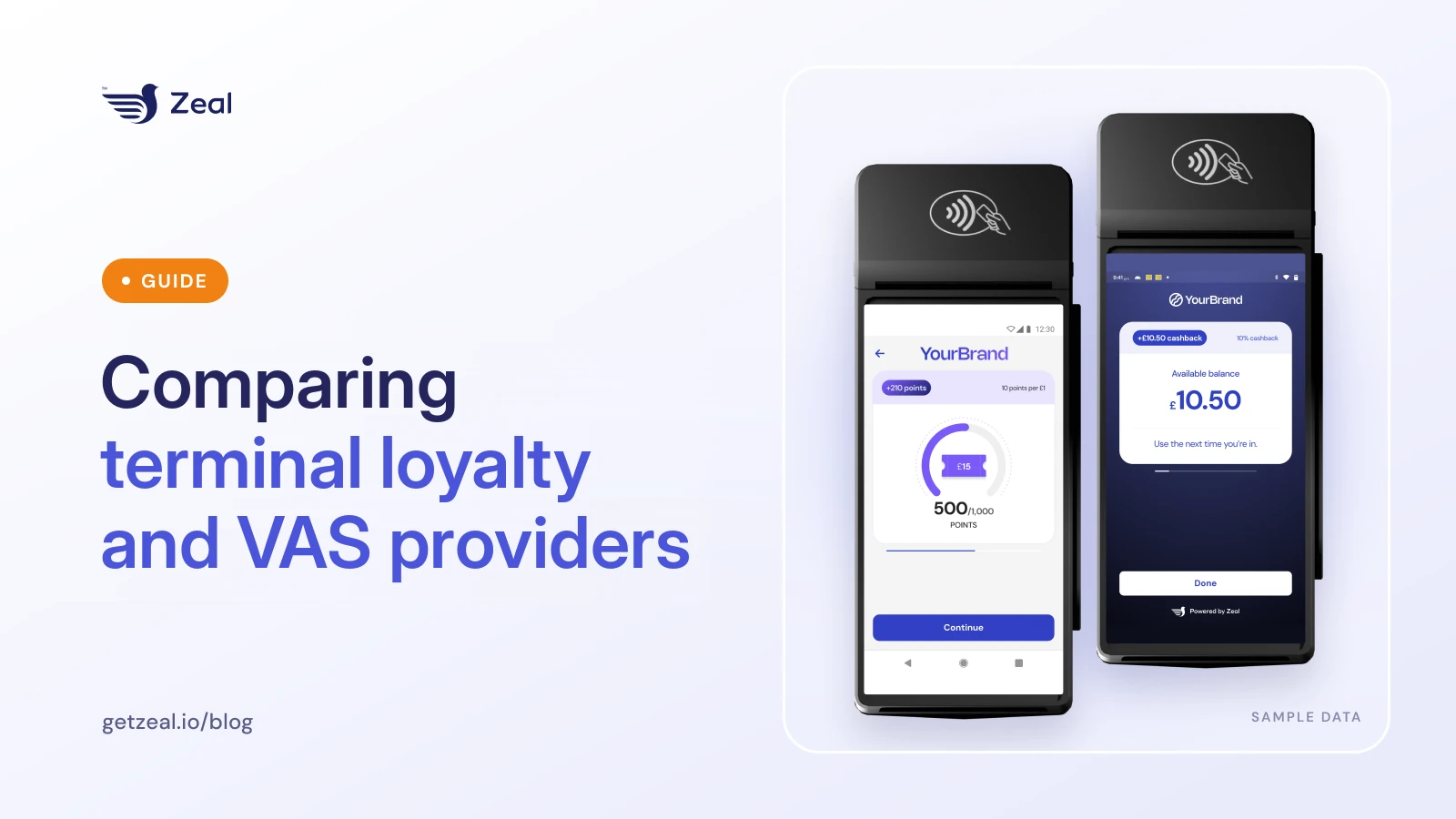
The software runs on the card machines merchants already use, as a value-added service alongside the payment application; this is what we mean by loyalty on card machines. The customer taps, the payment is processed exactly as before, and the loyalty logic runs around it. Staff do nothing different, so the queue does not slow down.
Because the identifier is the payment card rather than a scanned code, customers are recognised the next time they pay without having to remember anything. That changes what you can see: visit frequency, average spend and recency become measurable for customers who were previously anonymous. Our guide to loyalty without an app explains the options in full.
How much do loyalty cards cost a small business?
The visible price of a loyalty scheme is rarely the real one. Paper looks free and is not, and apps have a clear monthly fee plus a less obvious cost in customers who never sign up.
Paper has three cost drivers: printing, staff time and leakage. Printing is small. Staff time is not, because every stamp interrupts checkout and those seconds add up across thousands of transactions. Leakage covers copied stamps, over-generous staff and rewards on cards that were never properly earned.
Digital schemes move the cost to a subscription, often charged per site, sometimes with tiers based on customer numbers or message volume. Add design time, staff training and the effort of persuading customers to download an app or add a pass. Multi-site operators should check whether pricing is per location.
Card-linked loyalty is often arranged through your payment provider rather than bought as a separate tool, and availability depends on which card machines you use. Ask your provider what they offer.
Whichever format you choose, price the staff seconds. It is the line most merchants never calculate.
Do loyalty cards actually bring customers back?
Loyalty schemes change behaviour when they are easy to use and visible at the moment of purchase. They struggle when they depend on the customer doing extra work or on staff remembering to prompt during a rush.
The most common mistake is treating sign-ups as the success measure. A thousand app downloads looks impressive and tells you nothing about whether those people came back more often. The number that matters is visit frequency before and after joining, compared with customers who never joined. Most small businesses cannot calculate it, because paper schemes record nothing and app schemes only record the people who enrolled.
Our post on why shoppers join loyalty schemes but don't return sets out why reported engagement so often runs ahead of real repeat behaviour.
The test is simple. If you cannot see the same customer across two separate visits without asking them to identify themselves, your scheme is issuing rewards rather than building retention.
How to choose the right loyalty card for your business
Pick the format that matches how your customers already pay, not the one with the nicest marketing. Five questions settle it.
- How often do customers visit? Daily coffee trade suits low-effort formats. A salon visited every six weeks needs something the customer cannot lose between appointments.
- How fast is your checkout? If you serve a lunch rush, every extra second matters. Scanning a pass takes time; tapping a card does not add any.
- What data do you want? If you only want to give away a free tenth coffee, paper works. If you want to see visit frequency and spend, you need the transaction attached to an identifier.
- How many sites do you run? Multi-site operators need one customer record across locations, which rules out paper and can make per-site app pricing expensive.
- Which card machines do you use? Loyalty on card machines depends on your hardware and your payment provider, so check before you plan around it.
Answer those honestly and the right loyalty scheme for your business usually becomes clear. Our page on loyalty for small businesses walks through the options.
What I have learned putting loyalty on card machines
Omar Ebeid, Co-founder and CEO, Zeal:
In my experience, most independent merchants already own the device that sees every customer visit: the card machines on their counter. The data problem small businesses describe is often sitting in hardware they already pay for.
That is why Zeal puts loyalty and customer insight on the card machines merchants already use. There is no new hardware, no app for the customer to download and no change to how staff take a payment. In my experience, the schemes that last are the ones that ask nothing extra of the customer or the staff.
Zeal has activated more than 30,000 merchants across payment providers, and our partners have 4 million payment terminals in their signed activation pipeline. In the UK, Zeal is live with Adyen, DNA Payments, Elavon, Lloyds Cardnet, NMI, Viva Wallet and Worldpay.
Zeal won Team of the Year at the UK FinTech Awards 2026. The recognition is welcome, but the measure I care about is simpler: merchants who can finally see which customers came back.
Frequently asked questions
What is a loyalty card?
A loyalty card tracks a customer's repeat purchases and triggers a reward at a set threshold. It can be paper, a digital pass in a phone wallet, or the customer's own payment card.
Do loyalty cards work for small businesses?
Yes, when the format matches the business. Schemes that need no extra action at checkout tend to suit high-frequency trade like cafes, because they do not depend on staff prompting during a rush.
How much do loyalty cards cost?
Paper costs printing plus staff time at every transaction. Digital schemes usually charge a monthly subscription, often per site. Card-linked loyalty is often arranged through your payment provider, so ask what is available on your card machines.
Can my card machines run a loyalty scheme?
Often, yes. Many modern card machines can run value-added services alongside the payment application. Availability depends on your hardware and your payment provider, so check with them directly.
Are loyalty cards GDPR compliant?
They can be. You need a lawful basis for processing, clear information about what you collect, and a working way for customers to opt out. Ask any loyalty card providers you shortlist to show you how they capture consent and handle data.
You might also like