8 Best Terminal Loyalty and VAS Platforms for Enterprise Retail in 2026
Compare the best terminal loyalty and VAS platforms for enterprise retail in 2026, from software on the payment terminal to card linking and EPOS suites.

The best terminal loyalty and VAS platforms for enterprise retail are the ones that fit the payment terminals you already run. For a mixed estate spread across several acquirers, that usually means software that runs on the terminal itself. For a single-brand restaurant group, an all-in-one EPOS suite can be simpler. This guide covers eight platforms worth shortlisting in 2026: Zeal, Paytronix, PAR Punchh, Eagle Eye, Fidel API, Thanx, White Label Loyalty and Toast.
Key takeaways
- Start with the estate, not the rewards. Confirm which terminal models and acquirers a platform supports today before you compare loyalty features.
- There are three architectures. Software on the payment terminal (Zeal), card linking through the card networks (Fidel API), and app, EPOS or API-led platforms (Paytronix, PAR Punchh, Eagle Eye, Thanx, White Label Loyalty and Toast).
- Enrolment friction decides participation. Ask every vendor how a customer joins and how they are recognised on the next visit.
- Ask for evidence, not adjectives. Request supported device lists, the deployment method, the data-protection basis and named references.
How we compiled this list
Zeal is one of the eight platforms, so we have a commercial interest in this topic. Zeal is listed first because it is the platform we know first-hand; the list is not a ranking and is in no order of merit. Descriptions of the other seven come from each company's own website, linked in the text and checked on 10 October 2026. We have not run those platforms ourselves, so we describe how each company positions its product rather than how it performs.
The eight platforms at a glance
Table 1 summarises how each vendor describes itself.
| Platform | How the vendor describes it | Where it sits | Best fit |
|---|---|---|---|
| Zeal | Value-added services provider for payment terminals | Software on the payment terminal, deployed by the payment provider | Retailers and payment providers with mixed terminal estates |
| Paytronix | "Digital guest engagement platform" | Ordering, loyalty, messaging and payments suite | Multi-unit restaurants and convenience stores |
| PAR Punchh | Part of PAR Engagement, a unified marketing, ordering, loyalty and data suite | Engagement suite | Restaurant brands |
| Eagle Eye | AI-powered loyalty and personalisation platform built for retailers | AIR platform connected through APIs and pre-built connectors | Large grocery, convenience, fuel and hospitality brands |
| Fidel API | "One API for linking bank cards to applications, globally" | Card linking across Visa, Mastercard and American Express | Apps and rewards programmes that want card-linked offers |
| Thanx | "Restaurant Guest Engagement Software" | Guest engagement with 60+ EPOS and technology integrations | Restaurant groups |
| White Label Loyalty | API-first loyalty software and "AI-powered loyalty infrastructure" | Self-serve APIs through to enterprise deployments | Brands that need custom programme logic |
| Toast | Restaurant EPOS with integrated payments, loyalty and gift cards | All-in-one EPOS and payments stack | Restaurant groups adopting the full Toast stack |
1. Zeal: value-added services on the payment terminal
Zeal is an award-winning value-added services provider for payment terminals. Our SDK runs natively inside the terminal operating environment of the payment terminals a merchant already uses, which lets payment providers deploy it across mixed fleets without changing the payment acquirer. Returning customers are recognised from the card they pay with, with no app download and no separate loyalty card, and first-time customers can join from a prompt on the terminal. On top of that recognition sit loyalty, customer insight and remarketing for the merchant, and estate-level reporting for the payment provider.
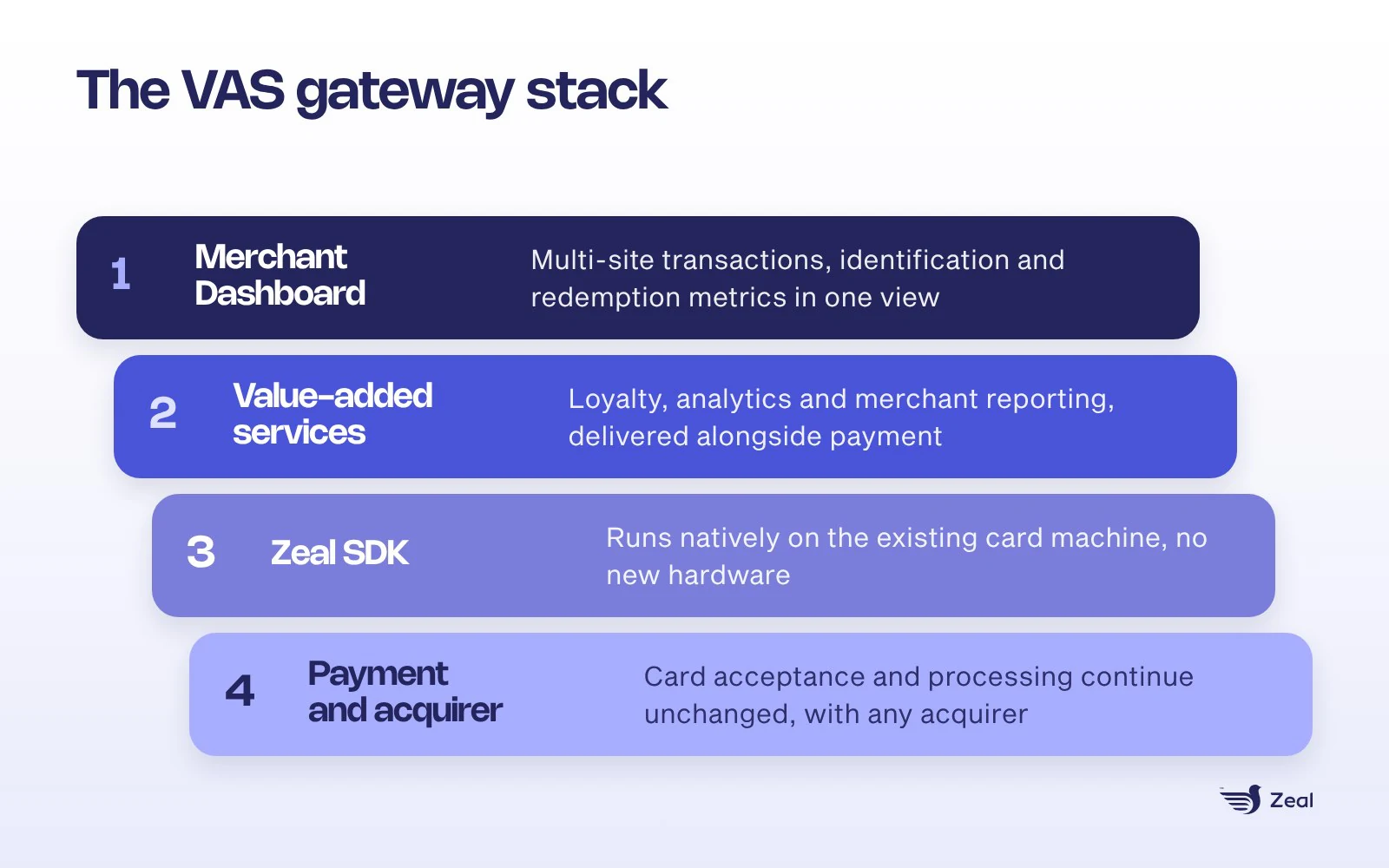
Figure 1. The value-added services gateway, from Zeal's guide to app-free loyalty: services sit on top of the terminal, and card acceptance stays with the acquirer.
Supported terminals include the PAX A920 and A77, Ingenico Move 5000, Castles S1F2 and Verifone T650c and V240m, deployed over the payment provider's terminal management system (the full table is further down). In the UK, Zeal is live with Adyen, DNA Payments, Elavon, Lloyds Cardnet, NMI, Viva Wallet and Worldpay, and it is activated for more than 30,000 merchants across payment providers.
Best fit: enterprise retailers and payment providers with mixed terminal estates who want hardware-agnostic loyalty integration without new hardware or a new acquirer.
What to check: that your exact terminal models are supported, and which of your acquirers can switch Zeal on today.
2. Paytronix: guest engagement for restaurants and convenience
Paytronix describes itself as a "digital guest engagement platform" that combines online ordering, loyalty, omnichannel messaging, AI insights and payments in one suite. Its site names multi-unit restaurants, small and medium restaurants and convenience stores, and it gives guests access to loyalty through a branded or custom app.
Best fit: restaurant and convenience brands that want ordering, loyalty and messaging from one vendor.
What to check: how guests are identified at the payment terminal in your stores, and what integration your EPOS and acquirer need.
3. PAR Punchh: loyalty inside the PAR Engagement suite
Punchh is now part of PAR Engagement, which the company describes as "a unified suite that connects marketing, ordering, loyalty, and data". Its site is written for restaurant brands and highlights AI-driven recommendations alongside personalised offers and rewards.
Best fit: restaurant brands that want loyalty, ordering and marketing in one engagement suite.
What to check: UK availability and support, and how the suite connects to the payment terminals in your stores.
4. Eagle Eye: real-time loyalty and promotions for large retailers
Eagle Eye describes itself as an AI-powered loyalty and personalisation platform built for retailers. Its AIR platform runs real-time loyalty and omnichannel promotions, and its site cites a library of pre-built connectors and customers including Tesco, Asda, Morrisons, Waitrose and Pret.
Best fit: large grocery, convenience, fuel and hospitality brands with complex promotions and the engineering capacity to integrate enterprise loyalty software.
What to check: where customer identification happens (app, card or EPOS) and who builds and maintains the EPOS connection.
5. Fidel API: card linking through the card networks
Fidel API describes itself as "one API for linking bank cards to applications, globally". It connects Visa, Mastercard and American Express cards to rewards programmes, and its products include real-time transaction data from partner merchants and a managed card-linked offers service.
The architecture differs from terminal software. A cardholder links a card once inside an app or programme, and qualifying transactions are matched through the card networks rather than on the merchant's terminal. We compare the two approaches in detail in Zeal vs Fidel API.
Best fit: apps, banks and rewards programmes that already have a customer relationship and want card-linked offers.
What to check: how customers link their cards, and which merchant locations and transactions are covered.
6. Thanx: restaurant guest engagement beyond discounts
Thanx sells "Restaurant Guest Engagement Software" for quick service, fast casual, table service and coffee concepts. It argues against relying on costly discounts, promotes rewards beyond discounts, and says it has more than 60 EPOS and technology integrations.
Best fit: restaurant groups focused on margin-safe guest engagement.
What to check: UK availability, and integrations with your EPOS and payment provider.
7. White Label Loyalty: configurable, API-first loyalty
White Label Loyalty describes its product as API-first "AI-powered loyalty infrastructure", offered "end-to-end or integrated", from "self-serve APIs to enterprise-grade solutions".
Best fit: brands that need custom programme logic and have developers to build the integration.
What to check: who builds the connection to your payment terminals and EPOS, and the total cost of that work.
8. Toast: an all-in-one restaurant EPOS and payments stack
Toast is a restaurant EPOS whose suite includes integrated payment processing alongside loyalty and gift cards. Its site offers a United Kingdom version and notes that product offerings and functionality vary by region.
Best fit: restaurant groups prepared to standardise on Toast's EPOS and payments.
What to check: whether you can keep your current acquirer and terminals, and the cost of replacing an existing estate.
How to choose: four questions for every vendor
- Which terminals and acquirers does it support today? Ask for the device list and the payment providers you can deploy through now, not the roadmap.
- How does a customer join, and how are they recognised next time? App downloads, phone numbers, linked cards and payment-card recognition produce very different participation, so ask for the enrolment flow step by step.
- What is the total cost across a mixed estate? Include integration work, certification, professional services and maintenance for every terminal model you run.
- How is customer data handled? Ask which lawful basis under UK GDPR the vendor relies on (the ICO's guidance on legitimate interests is a useful reference) and how card data stays within the scope of the PCI Security Standards Council requirements, such as PCI DSS and PTS POI.

Figure 2. Terminal-native recognition and a standalone app differ most on enrolment and identification.
How payment-card recognition works on the terminal
On a terminal-resident platform, two pieces of software share the payment terminal. The approved payment application keeps full control of card reading, authorisation and payment security. A separate value-added services layer receives an approved, non-payment reference for an eligible card, checks it against the merchant's loyalty profiles and returns a response, such as a recognition or enrolment prompt on the terminal screen.
That separation matters for compliance. In Zeal's reference architecture, the recognition flow excludes the PIN, CVV, full card number, payment cryptograms and payment keys. Even so, tokenisation does not automatically take an implementation out of PCI DSS scope: the PCI Security Standards Council's tokenisation guidelines explain that scope depends on the whole tokenisation system and its connected environment. A card reference can also still be personal data: the ICO's pseudonymisation guidance treats pseudonymised data as personal data when it can be attributed to a person with additional information. Ask every vendor to document both. Our technical guide to payment terminal customer recognition, on the Zeal blog, covers the architecture in detail.
What we have learned building software for payment terminals since 2019
I have spent seven years building software for payment terminals. In my experience, the platforms that work on a terminal estate are the ones that respect how that estate is run. I co-founded Zeal with Belal Mohamed in 2019. Through 2020 and 2021 we built the core technology. In 2022 and 2023 we spent two years in real-world merchant pilots, and the feedback from those pilots led directly to the improvements that shaped the product.
Three lessons from that work shape the questions above:
- We confirm the terminal first. In my experience, each terminal family has its own operating system and deployment route, so we check a merchant's exact model before anything is switched on. Today that means six supported models across PAX, Ingenico, Castles and Verifone.
- We deploy through the payment provider. Zeal goes out through our partners' terminal management systems, so merchants never have to install anything themselves.
- We agree data requirements up front. Integration and customer-data requirements are settled with each partner before deployment, not after.
The outcome so far: Zeal has grown from a two-founder start-up in 2019 to more than 30,000 merchants activated across payment providers, with seven live UK payment partners. As a result of those partnerships, 4 million payment terminals now sit in our partners' signed activation pipeline. We have raised $14 million in total, and the team won Team of the Year at the UK FinTech Awards 2026. From my experience of those rollouts, the vendors worth shortlisting are the ones that can show you the same evidence we ask of ourselves: a device list, a deployment route and a data agreement. Figure 1, Figure 2 and Table 2 are taken from Zeal's own product documentation.
Table 2. Terminals Zeal supports today
| Terminal | Operating system | Form factor | Deployment |
|---|---|---|---|
| PAX A920 | Android 5.1+ | Countertop or portable | TMS push |
| PAX A77 | Android 7.0+ | Countertop | TMS push |
| Ingenico Move 5000 | Telium TETRA | Portable | TMS push or side-load |
| Castles S1F2 | Android 10 | Countertop | TMS push |
| Verifone T650c | Android | Countertop | TMS push |
| Verifone V240m | Android | Portable | TMS push |
Source: Zeal's guide to terminal-based loyalty. Availability depends on the payment provider.
Frequently asked questions
What is terminal-based loyalty?
Terminal-based loyalty runs on or alongside the payment terminal, so customers can be recognised and rewarded at the moment they pay. Some vendors run software on the terminal itself; others connect to it through the EPOS or an API.
What is a value-added services gateway?
A value-added services gateway is a software layer on the payment terminal that lets payment providers offer services such as loyalty, analytics and merchant reporting without changing card acceptance. Our guide to value-added services on payment terminals explains the model in depth.
Do customers need an app for terminal-based loyalty?
Not when the software runs on the payment terminal: returning customers are recognised from the card they pay with. App-based and phone-number programmes need the customer to download, register or give details at checkout. Read more about payment-linked loyalty.
Can a retail loyalty system run on an existing acquirer's terminals?
It depends on the acquirer and the terminal model. Zeal runs on supported models through its live UK partners Adyen, DNA Payments, Elavon, Lloyds Cardnet, NMI, Viva Wallet and Worldpay, so merchants keep their acquirer and their hardware.
Sources
- Paytronix, company website, checked 10 October 2026.
- PAR Punchh, company website, checked 10 October 2026.
- Eagle Eye, company website, checked 10 October 2026.
- Fidel API, company website, checked 10 October 2026.
- Thanx, company website, checked 10 October 2026.
- White Label Loyalty, company website, checked 10 October 2026.
- Toast, company website, checked 10 October 2026.
- Information Commissioner's Office, Legitimate interests (updated 23 March 2026).
- PCI Security Standards Council, Standards overview and tokenisation guidelines (information supplement).
- Information Commissioner's Office, Pseudonymisation.
About the author
Omar Ebeid is Co-founder and CEO of Zeal, which he founded with Belal Mohamed in 2019. He holds an MSc in Entrepreneurship from the University of Bath and won the Vice-Chancellor's Award at the University of Surrey. Under his leadership Zeal won Team of the Year at the UK FinTech Awards 2026 and Platinum at the Juniper Research Future Digital Awards 2023, and has raised $14 million in total, including a $10 million pre-Series A round announced on 9 September 2026. Connect with Omar on LinkedIn.
Related reading
You might also like

