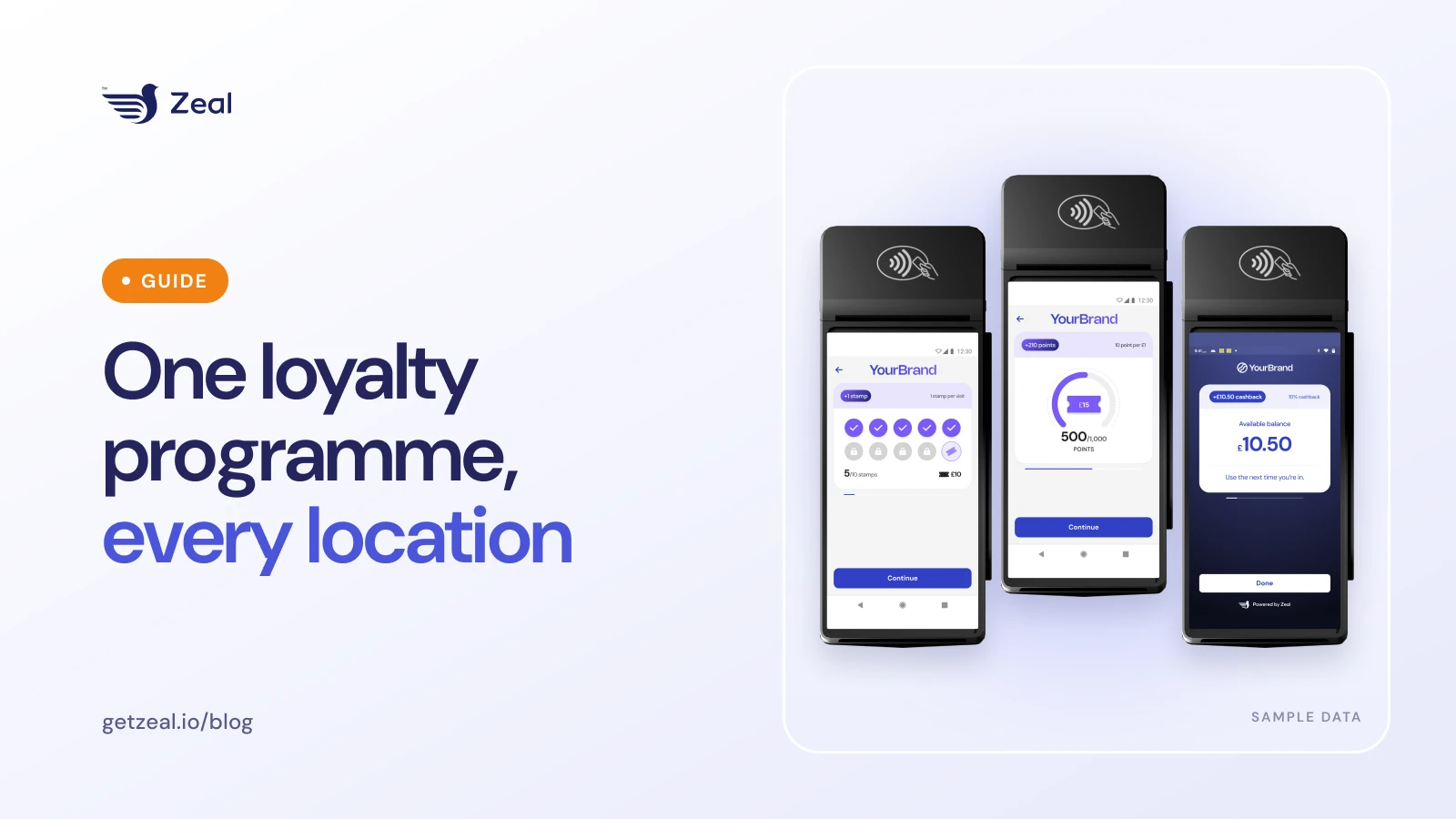
How to Run a Loyalty Programme Across Multiple Locations
How to run a loyalty programme across multiple locations: map MIDs and terminals, set funding rules, agree data roles and roll out in phases.

Here is how to run a loyalty programme across multiple locations: keep one set of programme rules and one customer ledger at brand level, then map every site, operator, merchant ID (MID) and payment terminal to it. In a franchise, each location may be a separate business with its own MID, acquirer and EPOS, so you also need written rules on who funds rewards, who controls customer data and in what order sites join. Then deploy in phases: pilot a few representative sites, check that points and reimbursements reconcile, and expand in waves.
Key takeaways
- One programme, many operators. Customers see one membership; behind it, each franchisee may have its own company, MID, acquirer and EPOS.
- Map the estate before you choose software. List every site, operator, MID, terminal ID (TID), terminal model and payment provider.
- Write the money rules down. Decide who funds a reward earned at one site and redeemed at another, and how the redeeming site is reimbursed.
- Settle data roles purpose by purpose. Franchisor, franchisee and technology provider can be controllers, joint controllers or processors for different purposes.
- Roll out in phases. Pilot, reconcile, then expand in cohorts with a rollback plan.
How we put this guide together
This guide draws on UK regulator guidance (the ICO and the Payment Systems Regulator), payment provider documentation and published programme terms, all linked and checked on 10 October 2026, together with what we have learned deploying loyalty on payment terminals since 2019. Zeal sells value-added services for payment terminals, including loyalty, so we have a commercial interest in this topic. Nothing here is legal or accounting advice: take your own advice on franchise agreements, data protection and the accounting treatment of rewards.
What one programme across many locations really means
A shared loyalty programme across locations means customers get the same membership, earning rules and rewards wherever they shop in the network. It does not mean every location shares the same company, bank account, acquirer or EPOS. Well-run programmes make participation explicit: McDonald's UK, for example, limits its rewards to restaurants in the UK, Jersey and the Isle of Man that participate in the scheme, and its MyMcDonald's Rewards terms warn that not all participating restaurants sell every reward product.
Payment set-ups vary just as much. Adyen's guidance on account structure says "A common setup is to use one merchant account for each business unit or physical store location", with each location getting "their own separate reporting and payout of funds", and asks merchants to involve their finance department because the structure "influences the bank settlement". Your programme has to sit above all of that.
Table 1. The multi-location hierarchy and what to record at each level
| Level | Example | What to record | Why it matters |
|---|---|---|---|
| Programme | The brand's loyalty scheme | Rules version, rewards, currency | One promise to every customer |
| Operator | Each franchisee company | Legal entity, franchise agreement, participation status | Funding, liability and data roles |
| Merchant account | One MID per operator or site | Acquirer, MID, settlement account | Reconciliation and reimbursement |
| Location | Each site | Store ID, address, opening date | Reporting and local offers |
| Payment terminal | Each device | TID, model, operating system, payment application, TMS | What software can run, and who deploys it |
How to run a loyalty programme across multiple locations in seven steps
- Map the estate. Build one register of every site, operator, MID, TID, terminal model, payment provider and EPOS. Supported terminal models vary, so confirm each one before you promise customers anything.
- Decide what is shared and what is local. Fix the brand-wide earn rate and core rewards centrally, and agree which local offers a franchisee may run on top. Keep a participation register showing which sites allow joining, earning and redemption.
- Write the funding and reimbursement rules. Agree who pays for each reward, how the redeeming site is reimbursed, how often balances are settled, and how refunds and reversals flow back.
- Allocate data roles. Decide, purpose by purpose, who is controller, joint controller or processor, and put it in writing before any customer data moves.
- Choose how customers are recognised at every site. Use one method that works on every participating terminal, whether that is the card at the payment terminal, an app or a phone number, so cross-location loyalty rewards behave the same everywhere.
- Pilot a representative cohort. Include each operator type, terminal model and EPOS in the pilot, and set success, failure and rollback criteria before launch.
- Expand in waves and review. Add sites in cohorts, keep a version history of programme rules, and review funding and data arrangements as the network grows.

Figure 1. A controlled rollout, step by step, from Zeal's guide to value-added services on payment terminals.
Separate operators, separate MIDs: what changes in a franchise
In a franchise, the locations in your programme are usually separate businesses. Each franchisee signs its own acquiring contract, holds its own MID and may rent terminals from a different provider. That is normal, and a well-designed programme does not need everyone on one acquirer.
Switching everyone to one provider is rarely quick anyway. The Payment Systems Regulator's card-acquiring market review found that terminal contracts can run for longer initial terms than acquiring contracts, for example three or five years, and that a merchant that switches acquirer will typically need a new terminal. Under the PSR's 2022 remedies, the 14 most significant card-acquiring providers have had to cap terminal lease and rental contracts at 18 months, with a rolling monthly contract after that, since January 2023. Plan the programme around the estate you have, not the one you would like.
This is why franchise loyalty software should be acquirer-agnostic where possible. Zeal, for example, is deployed by payment providers rather than by each franchisee, and in the UK is live with Adyen, DNA Payments, Elavon, Lloyds Cardnet, NMI, Viva Wallet and Worldpay.
Funding rules: who pays when a customer earns in one place and redeems in another
Cross-location redemption is where a franchise programme needs its clearest rules, because the site that earns the revenue is not always the site that hands over the reward. Table 2 sets out four common funding models.
Table 2. Four ways to fund cross-location loyalty rewards
| Model | How it works | Suits | Watch out for |
|---|---|---|---|
| Earning site funds | The site where points are earned carries the cost and reimburses the redeeming site | Networks where sites trade at similar levels | Needs regular settlement between operators |
| Central fund | A brand marketing fund pays for rewards | Franchisor-led programmes | Contributions must be set out in the franchise agreement |
| Redeeming site funds | The site that hands over the reward carries the cost | Simple programmes with little cross-site traffic | Busy destination sites can carry more cost than they earn |
| Shared formula | Costs split by an agreed formula | Mixed estates | The formula must be simple enough to audit |
Whichever model you choose, write down the reimbursement value of each reward, the settlement cycle, what happens to points on refunded purchases, and what happens to balances when a franchisee leaves the network.
Data roles: controller, processor or joint controller?
UK GDPR roles follow decisions, not job titles. The ICO's guidance on controllers and processors defines a controller as the party that "alone or jointly with others, determines the purposes and means of the processing of personal data", and a processor as one that "processes personal data on behalf of the controller". The ICO notes that this guidance is under review after the Data (Use and Access) Act.
In a franchise, the answer can differ by purpose. Table 3 shows the questions to settle.
Table 3. Data roles to settle, purpose by purpose
| Purpose | Who usually decides | Possible role | What to document |
|---|---|---|---|
| Running the brand programme | Franchisor | Controller, possibly jointly with franchisees | Privacy notice and lawful basis |
| Recognising customers at each site | Merchant and technology provider | Joint controllers or controller and processor, depending on the contract | Joint controller arrangement or processor contract |
| A franchisee's own marketing | Franchisee | Controller for its own marketing | PECR consent or soft opt-in records |
| Reporting results to the franchisor | Franchisor | Controller or processor, depending on the purpose | Data-sharing agreement |
The documents differ by role. The ICO says joint controllers need "a transparent arrangement that sets out your agreed roles and responsibilities", that its main points "should be made available to individuals", and that "individuals must remain able to exercise their rights against each controller" (ICO). Where a processor is used, "there must be a written contract (or other legal act) in place" (ICO).
Marketing needs separate care. For the PECR soft opt-in, the ICO says "You must obtain the contact details directly from the person you want to send the electronic mail marketing to", so decide which entity collects contact details and which entity sends marketing before any message goes out.
For a worked example, Zeal publishes its own joint controller arrangement. When a customer joins a merchant's programme through Zeal, Zeal and that merchant are joint controllers for joining, recording purchases, calculating and redeeming rewards and messages sent on the merchant's behalf; each arrangement covers one merchant's programme only, and Zeal's cross-merchant card recognition is run by Zeal alone as an independent controller. In a franchise, that means deciding which entity is "the merchant" for each programme.
How payment terminals help multi-location customer loyalty
The payment terminal is the one touchpoint every card-paying customer uses at every site, which makes it a natural anchor for multi-location customer loyalty. Zeal's SDK runs on supported terminals alongside the existing EPOS and payment processing, and the payment provider deploys it through its terminal management system (TMS), so franchisees do not install anything themselves. Payment providers see estate, merchant and VAS activity in the Zeal PSP Portal, and merchants get customer insight and campaign tools in the Merchant Dashboard.
Recognition depends on the customer paying by card or mobile wallet on a supported terminal, and customers join with a prompt on the terminal rather than an app download. Brands that also want an app can add a white-label app for ordering and bookings on the same profiles. Our guide to value-added services on payment terminals explains how payment providers deploy and govern these services across an estate.
What we have learned rolling out loyalty across estates
I co-founded Zeal with Belal Mohamed in 2019. In my experience, multi-site programmes succeed or fail on the estate register, not the rewards catalogue. We built the core technology in 2020 and 2021 and then spent two years, 2022 and 2023, in real-world testing; the merchant feedback from those pilots guided the improvements that shaped the product.
I have spent seven years rolling out software on payment terminals, and three lessons shape the steps above:
- We confirm the terminal first. In my experience, supported models vary, so we check each site's exact payment terminal before anything is switched on.
- We deploy through our partners. Zeal goes out through payment providers' terminal management systems, site by site and cohort by cohort.
- We agree data requirements up front. Integration and customer-data requirements are settled before deployment, which is why step 4 comes before step 5.
The outcome so far: more than 30,000 merchants activated on Zeal across payment providers, seven live UK payment partners and 4 million payment terminals in our partners' signed activation pipeline. We have raised $14 million in total, and the team won Team of the Year at the UK FinTech Awards 2026, as our press page records. Tables 1 to 3 are our own working frameworks; Table 4 comes from Zeal's guide to terminal-based loyalty, and Figure 1 is one of Zeal's own explanatory graphics, first published on the Zeal blog.
Table 4. Payment terminals Zeal supports today
| Terminal | Operating system | Form factor | Deployment |
|---|---|---|---|
| PAX A920 | Android 5.1+ | Countertop or portable | TMS push |
| PAX A77 | Android 7.0+ | Countertop | TMS push |
| Ingenico Move 5000 | Telium TETRA | Portable | TMS push or side-load |
| Castles S1F2 | Android 10 | Countertop | TMS push |
| Verifone T650c | Android | Countertop | TMS push |
| Verifone V240m | Android | Portable | TMS push |
Source: Zeal's guide to terminal-based loyalty. Availability depends on the payment provider.
Frequently asked questions
Can customers earn at one location and redeem at another?
Yes, if both sites participate in the same programme and the ledger records which operator funded the points and which site handed over the reward. Publish the list of participating sites, and say clearly if some products or sites are excluded.
Does a shared loyalty programme across locations need one MID or one acquirer?
No. A programme can sit above many MIDs and several acquirers, as long as every transaction maps to the right operator, site and terminal. Choose recognition that works on each payment provider in your estate rather than forcing franchisees to switch.
Who owns the customer data in a franchise loyalty programme?
There is no single answer. The franchisor, franchisees and technology provider can be controllers, joint controllers or processors for different purposes, so map each purpose and document it, as the ICO's guidance on controllers and processors describes.
What should franchise loyalty software do?
It should keep one ledger across sites, record which operator funded each reward, give each franchisee its own reporting, and work on the terminals and payment providers already in the estate. It should also support phased rollout and rollback, so new sites can join without disrupting live ones.
Should a centralised loyalty programme allow local offers?
Usually, within limits. Keep the core earn rate and rewards central so customers get one promise, and let franchisees fund local offers that are clearly labelled and settled locally.
Sources
- McDonald's UK, MyMcDonald's Rewards terms and conditions, checked 10 October 2026.
- Adyen, Determine your account structure, checked 10 October 2026.
- Payment Systems Regulator, Market review into the supply of card-acquiring services: final report, November 2021.
- Payment Systems Regulator, PS22/2 Card-acquiring market remedies: final decision, 6 October 2022.
- Information Commissioner's Office, What are controllers and processors? (under review).
- Information Commissioner's Office, What does it mean if you are joint controllers? (under review).
- Information Commissioner's Office, Contracts (under review).
- Information Commissioner's Office, How do we comply with the PECR electronic mail marketing rules?, 2 October 2026.
- Zeal, Joint controller arrangement, last updated 24 September 2026.
About the author
Omar Ebeid is Co-founder and CEO of Zeal, which he founded with Belal Mohamed in 2019. He holds an MSc in Entrepreneurship from the University of Bath and won the Vice-Chancellor's Award at the University of Surrey. Under his leadership Zeal won Team of the Year at the UK FinTech Awards 2026 and Platinum at the Juniper Research Future Digital Awards 2023, and has raised $14 million in total, including a $10 million pre-Series A round announced on 9 September 2026. Connect with Omar on LinkedIn.
You might also like

